This blog details my father's experience as a Montford Point Marine. The Montford Point Marines were the nation's First Black Marines, and they served bravely in a branch of the military that initially refused to accept them. The Montford Point Marines exceeded expectations and served tenaciously in World War II and The Korean War. These surviving men were finally recognized by Congress and received the Gold Medal of Honor as a group on June 28, 2012.
Prior to the United States entering World War I in 1917, there were four Black regiments in existence: The 9thand 10th Cavalry and the 24th and 25th Infantry. The men in these units were well regarded in their respective communities. Collectively they were known as the Buffalo Soldiers. The Militia Act of July 17, 1862, allowed Blacks to serve in the Army. On July 28, 1866, Congress also permitted Black soldiers to serve as peacetime Army soldiers after the Civil War. (1861-1865). I stated previously that the Buffalo Soldiers received a Medal of Honor as a group, and I will describe their comprehensive and exciting history in the future. The War Department needed additional soldiers for The Great War, also known as World War I, in 1917. Black Volunteers quickly reached their quota.
The image of Civil War President Abraham Lincoln looms over the
Black WWI Soldiers fighting abroad in this painting.
Source:blsciblogs.baruch.cuny.edu
More than 350,00 African Americans served in segregated units during World War I. Historycentral.com, reports that 1, 400 served as officers. Emmett J. Scott worked for eighteen years as the private secretary to Negro leader Booker T. Washington. He then became Special Assistant to Secretary of War Newton Baker. It was Scott's job to "oversee the recruitment, training, and morale of the African American Soldier." Scott authored the Official History of the American Negro in the World War in 1919, with assistance from author Alice Dunbar Nelson and Carter G. Woodson. Woodson is the creator of Negro History Week during the month of February; Negro History evolved into Black History Month. (www.pbs.org/jimcrow/stories/_events_ww1.html.)
Yet in a secret memo by General John J. Pershing, concerning African American troops sent to the French military: We must not eat with them, must not shake hands with them, seek to talk to them or to meet with outside the requirements of military service. We must not commend too highly these troops , especially in front of white Americans.
It was also reported that:
"Even when integrated into fairly progressive camps, black soldiers were often treated badly and sometimes went for long periods without proper clothing. There were also reports of blacks receiving old Civil War uniforms and being forced to sleep outside in pitched tents instead of warmer, sturdier barracks. Some were forced to eat outside in the winter months, while others went without a change of clothes for months at a time."(Derived from militaryhistory.online/fighting for respect.) The newly created 93rd Division was composed of National Guard Units from several states and the 92 Division were comprised of draftees. General Pershing brokered a deal with the French to have the Black combat soldiers fight along side the French, since white soldiers did not want to fight along side with Blacks in battle. The French desperately needed fresh soldiers and eagerly accepted American Blacks on the front lines.
"The Harlem Hellfighters" 369th Infantry was the first to fight for America during this first global conflict. They fought wearing French Helmets and under the French flag. This unit was highly decorated. The 369th Infantry helped to stop the German offensive and launch a counter offensive. They spent 191 days in combat, longer than any other American unit in the war. One hundred and seventy one Blacks were awarded the military highest honors. The honors came from the country of France, not the United States.
Henry Johnson (1897-1929) was a Private in the 369th Army Infantry. Johnson fought off a group of German soldiers with only a bolo knife and a gun and even rescued an injured comrade. His son stated, "He got wounded twenty one times and what he did was stop the Germans from getting through the French line." He received military honors from the French Army. Henry Johnson received American accolades posthumously: the Purple Heart in 1996 and the Army's distinguished Service Cross in 2003. Henry Johnson is buried in Arlington National Cemetery.
Henry Johnson
Source: blog.oregonlive.com
Eugene Bullard (1895-1961) joined the French Army during the early years of WWI. Bullard was wounded several times during the war and became the first African American fighter pilot in military history. A biography, Black Swallow of Death, describes his heroic exploits. Bullard was forced to return to the States in the 1940s due to his French resistance activities and the Nazis.
First African American WWI fighter pilot,
Eugene Bullard, nicknamed the Black Swallow of Death
Source: nationalmuseumaf.mil
Croix de Guerre, highest military
awarded during WWI
Source:raycityhistorywordpress.com
*The Harlem Hellfighters, the nickname given to the 369th Infantry, were not permitted to participate in the farewell parade of New York's National Guard, the so called Rainbow Division. Why? because Colonel Haywood informed them that Black was not a color in the rainbow! Normally after victory is declared celebrations take place.(www.pbs.org/jimcrow/stories/_events_www1/html.) The 369th were given an alternative parade.Thousands welcomed these returning soldiers. Unfortunately, for my father, a Montford Point Marine, he received no parades or honor as a WWII combat soldier after his tour of duty. Many surviving Montford Point Marine Vets share the same bittersweet narrative.
My grandfathers did not serve in World War I. They did not make the age requirement. On May 18, 1917, the United States Congress passed the Selective Service Act. The act required males from the ages of 21 through 30 to register for the draft. When the United States declared war on Germany, the War Department knew that the paltry number of 126,000 Army men would not be enough to defeat the Central Powers.*
Meanwhile, Negroes wanted to prove that they were loyal and patriotic. They felt that this would improve their status as second class citizens. So they signed up in droves, eager to serve their country. The eagerness to sign up was very similar to the positive sentiment demonstrated during World War II.
Uncle Sam represents the US Government.
Some Black men showed apathy and outright refusal to fight in World War I. " The Germans ain't done nothin' to me and if they have, I forgive 'em." (Source: exhibitions.nypl.org). This comment by a Harlem resident, eerily reminds me of former heavyweight champion Muhammad Ali's remark about the Vietcong, some five decades later when he refused to fight in the Vietnam War. (See earlier post, "Dad Decides To Become A Marine"). A small fraction of Black men thought it was wrong to sign up for the war overseas. The US Government passed the June 1917 Espionage Act and the May 1918 Sedition Act "to crack down on dissent". Negro leaders were under surveillance because of their anti-war rhetoric.
A. Phillip Randolph
photo courtesy of 2bpblogspot.com
A magazine called The Messenger was founded by A.Phillip Randall (1889-1979) and Chandler Owen in 1912. It called for "more positions in the war industry and the armed forces for Blacks". A Phillip Randall worked tirelesslesly to organize Black workers and fight discrimination throughout his lifetime. He established the first Black labor union and challenged both President Franklin Delano Roosevelt and President Harry S. Truman to end discrimination in the federal government and the armed forces. Randolph would ultimately be responsible for President Truman signing Executive Order 9981, which prohibited segregation in the armed forces. But this historical feat was accomplished much later, in the year 1948. (Source: www.britannica.com)
I learned today that Black men were required to tear one corner of their registration cards so they could easily be identified and inducted separately. In the South, draft boards were doing all they could to bring Negros into service. They were less likely to be exempt from service. Of course, by serving I am referring to positions such as stevedores, cooks, drivers, and support positions. It was decided that "they were better suited in manual positions". (info derived from militaryhistoryonline.com)
Source: theotheralexandria.com
The torn right corner immediately identified Blacks.
In addition to the intense enlistment of Black soldiers, I discovered that Southern postal workers deliberately withheld the registration cards of eligible Negros men. Why? This practice was done to have them arrested and jailed as draft dodgers. These men owned their own farms and had families. Sadly, it was a deplorable way for those in power to break up the family unit, weaken the Negro man, and financially profit from taking their farms. The farms were a source of pride in the South, particularly since Negroes were descendants of sharecroppers and enslaved Africans.
This deliberate scheme reminds me of how people who wish to harm others convene and plot for the demise of another group for financial gain. One example is the often touted "School to Prison Pipeline for Black Boys". It is also refered to as the Prison Industrial Complex. Social rights activist icon Angela Davis eloquently describes mass incarceration in the video below:
The image of Uncle Sam is shown in this video.
Human trafficking is another example of how a group of people will exploit another set of individuals. Young woman are lured to this country with the promise of a job, and a better standard of life. These women use their life savings to go to America, the land of opportunity. But unbeknownst to the women, once they arrive their passports are taken from them along with their money and the women are forced to work as slaves. Another scenario is when females are given housing or a meal, and then coerced to participate in a lurid, unsafe lifestyle.
***
I would be remiss to not discuss the role of Black Women in the Great War effort and several exceptional African American World War I combat divisions. These contributions will be the subject of my next post. Again, all branches EXCEPT the Marines Corps accepted African Americans. The Marines did not accept African Americans until World War II.
Source: Angelfire.com
WWI Soldiers
* Notes: military historyonline.com/wwi
stevedore: one who is employed in the unloading of ships.
Uncle Sam: nickname for the US Government. His origins were based on an actual person by the name of Samuel Wilson, whose firm had a contract to provide meat for soldiers during the War of 1812. The artist who created the portrait was named James Montgomery Flagg.(xroads.virginia.edu.)
Angela Davis: Social rights advocate, professor, civil rights activist, former member of the Communist Party and Black Panthers. Davis was born in Birmingham, Alabama in 1944. She has authored many books, and
lectures throughout the world.
I had previously discussed the fact that the United States entered World War II after the surprise morning attack on Pearl Harbor on December 7, 1941. But it is also imperative to discuss World War I. The first World War was brought on by the assassination of Archduke Ferdinand of Austria in Sarajevo, Bosnia, on June 28, 1914. The political unrest ushered in a new era of fighting wars: The introduction of chemical gas, trench warfare, machine guns and tanks. World War (also known as the Great War) was aptly named because of the unparalleled amount of casualties and destruction involving many nations. World War I included the Central Powers of Germany, Austria-Hungary, the Ottoman Empire, vs the Allies. The Allies consisted of Great Britain, France, Russia, Italy and Japan, and later the United States of America. (Source: www.history.com)
Incidentally, African American Garret Morgan invented the gas mask 1914. His gas mask was originally used to rescue trapped men in an underground tunnel. Morgan's gas mask was later refined for use against chemical warfare in WWI. He was also the inventor of the traffic light; because of this brilliant man millions of people owe their lives. (Source: inventors.about.com.)
Source: www.paterson. k-12.nj.us
The concept of the tank was developed in 1914 by the British. The tank was needed to cross enemy lines and trenches. A British Army colonel named Ernest Swinton and William Henkey went to then British Navy minister Winston Churchill. Churchill championed the idea of developing a "land boat". The rest, as they say, is history. In September of 1915, the first tank came into being, albeit a clumsy one. Here is a video of the tank, called "Little Willie", below:
What caused the United States to become involved in WWI? According to www.historylearningsite.co.uk: America entered World War One on April 6th, 1917. Up to that date, America had tried to keep out of World War One - though she had traded with nations involved in the war- but unrestricted submarine warfare, introduced by the Germans on January 9th, 1917, was the primary issue that caused Woodrow Wilson to ask Congress to declare war on Germany on April 2nd. Four days later, America joined World War One on the sides of the Allies.
The Ottoman Empire included Turkey and was once the world's greatest independent Islamic power.
Source: nationalarchives.gov.uk
Unrestricted submarine warfare was the use of sinking merchant and passenger ships, vessels that included American passengers. President Woodrow Wilson had for the longest promised to keep the United States out of World War I. But the loss of innocent American lives compelled Wilson to act.
Decisive battles led to the brutal defeat of the Central Powers by the Allies in November, 1918. Europe was essentially decimated and countries were left in ruins. No other war in the history of mankind at the time had caused such rampant destruction. It has been estimated that over nine million lives were lost and twenty one million soldiers and civilians were injured as a result of this war from both sides. ( Source: history.com)
The Treaty of Versailles was signed on June 28, 1919. This was an extensive document and was primarily negotiated by the Big Three: Woodrow Wilson of America, David Lloyd George of Britain and Georges Clemenceau of France. George and Clemenceau wanted Germany punished so that another war of its magnitude would never happen again. Woodrow Wilson of America "could not understand how an advanced civilization could have reduced itself so that it had created so much devastation." America opted for non-intervention policies.
The Treaty of Versailles signed in 1918 determined post-war borders from Europe to the Middle East, established the League of Nations as an international peace organization and punished Germany for its aggression with reparations and the loss of territory. Tragically the instability caused by World War I would help make possible the rise of Nazi leader Adolf Hitler. -History.com
Also around this time The Russia Revolution had occurred. The Russian Revolution was the overthrow of imperial tsar rule in Russia and led to the creation of the Soviet Union under the Communist Party. British leader David Lloyd George had concerns of Communism* spreading throughout Europe in the future when signing the Treaty of Versailles. Furthermore, The Spanish Flu left over twenty fivemillion people dead. Such was the dire background of World War I.
*Communism- a type of government that relies on collectivization of labor and good to equal out the (socio-economic) classes. (obtained from www.howstuffworks.com/communism.html)
Dorothy Primus was born in 1931 in Nashville, TN. She grew up in a middle class household where her dad ( Frederick Brooks) was a railroad worker. In the forties for a Colored Person, a railroad worker was an enviable job, because it was steady work, and it had great benefits. (Another example would be employment at the post office during that era, now-- not so much) My maternal grandmother, Ellen Brooks, I never met, but she was a housewife and quiet. Mom had two sisters, and was considered beautiful. As a young girl she was a majorette, played classical and blues piano and represented her schools via beauty titles. Beauty Pageants are really big in the American South. (Witness the Honey Boo Boo reality show phenomenon on TLC). Mom attended Pearl High School in Nashville, TN.
In school my mother was picked on because of her long hair that cascaded down her back. She said that after school my grandmother would chastise her. Mom was reprimanded because the girls did Mom's hair in a different style than Grandma sent her to school.
However, other girls would then taunt her and call Mom "Horse Hair". So on one hand the girls were praising her hair, and on the other, her classmates would say cruel things about her. Some of my readers might have friends and family members who have a multi-racial or "ambiguious" appearance. They ultimately have the same painful story of someone staring at them intently, taking in their features, examining their hair texture. Usually an insensitive remark or back-handed compliment follows.
The taunting and drama also reminds me of Spike Lee's 1988 film, School Daze, where at a HBCU intra-racism was explored by the "Jiggaboos" vs the "Wannabees". This theme was one of many themes explored in this motion picture. Spike Lee intentionally separated the cast members to create tension on the movie set. Famous actors in School Daze included Laurence Fishbourne, Giancarlo Esposito, Samuel L. Jackson, Jasmine Guy, and Tisha Campbell Martin.
Dorothy Primus was also light skinned which confounded her problems. Students would accuse her of thinking that she was better than them. The intra-racism coupled with favoritism was a source of contention for my mom. She really was focused on her education, and graduated from high school early with the intention of majoring in business education at Tennessee State University. Mom was 5"7", (5'7'' and up is considered tall for females) had a great figure, and scores of folks urging her to run for Miss Tennessee State. Her dispostion was mild mannered and Mom was a typical southern gal.
Mom in her late teens.
My mother had broad African features, but also almond shaped eyes. She met my dad, Montford Point Marine, Clifford Primus, as a college freshman at TSU. Dad is eight years older than my mom and had just transferred from Fisk University. They would joke about their courtship, and how my mom poured her alcoholic drink in a plant when he wasn't looking. Mom was trying to impress my dad and appear cosmopolitan. My parents often talked about all the happening spots in Nashville, and my mother's various relatives that lived in nearby Thompson Station.
Source: Black Collegiatv.net
Source: hbcudigest.com
The two of them would share with me the fact that the African Students that attended schools in Nashville were not subject to segregation. Africans were treated better than American Blacks because they were foreign. The aforementioned "Pretty Willie" from the previous post decided to don a head turban and pretend that he was an African student. He was able to sit in lower level of the segregated movie theater with the white patrons instead of the upper level balcony seats where the colored folks had to sit. Dad said he and his classmates pelted "Pretty Willie", faux Africans and actual Africans with spitballs in protest. Additionally, Black college students who were "passing" occupied seats in the whites only section. They too, received spitballs from their darker skinned college classmates.
Dad explained that while at Fisk, the first dark skinned Miss Fisk, was nominated. Her name was Florence Brocheau and a segment of veterans helped her get nominated. Many of the students that attended Fisk were descendents of mixed race unions from slavery. Fisk was founded after manumission by an official from the Tennesse Freedmen's Bureau. The school's objective was to provide educational opportunities for former slaves. W.E. B. Dubois, an alumni/ faculty member at Fisk and founder of The NAACP (National Association for the Advancement of Colored People) has a famous quote:
"The problem of the twentieth century is the problem of the color-line--the relation of the darker to the lighter races of men in Asia and Africa, in America and the islands of the sea. It was a phase of this problem thatcaused the color line."
Clifford and Dorothy Primus
Source: Primus Family
I had a maternal great Aunt Bessie, a domestic, who worked for a wealthy white family. Aunt Bessie always walked around with her large purse. Aunt Bessie carried her purse like the commedienne Sheryl Underwood from CBS's "The Talk" did during her comedy sets. Aunt Bessie and her husband Clem resided waaay in the back of her employers' property. They lived in the slave, I mean, "the help" quarters.
Whenever Dad would visit Aunt Bessie's employers Dad would affect an antebellum Negro servant accent, and peppered his speech with lots of "yessums" and "ma'm"s. He would clown around and get a country ham out of his Academy Award winning performance, and then laugh at their expense. The truth of the matter is that my father is a militant person; he is the type of person that will look around a business establishment and demand, "How come you don't have any black people working here?!" He then would watch the individual turn beet red and hem and haw. Eventually a person of color would be hired.
It turns out that in my mom's youth that she was a "playmate" for the daughter of Aunt Bessie's employer. The little girl had to be referred to as "Miss Kitty", due to post-slavery southern conventions. Mom was rewarded with a truckload of clothing being a friend for this little girl. "Miss Kitty" and my mom were two children roughly the same age. One child was given a title in front of her name because of her race and socio-economic status.
My folks relocated to Hartford, CT and were married in June of 1949. They had a daughter and then seven years later a son. Ten years later Clifford and Dorothy had fraternal twins, one of them being me. Even though my mom lived in New England for over sixty years, she never lost her Nashville accent. She was unassuming, and was not materialistic. Degrees did not impress her. Greek Letters or the latest designer hand bags did nothing for her. She would talk to everyone, and never looked down on people because of their income.
Dorothy Primus was a member of Jehovah's Witness for fifty one years. She knew her bible and whenever she used to talk about her spirituality she was peaceful and evolved into Fluent Scholar Mode. At age 34 she developed rheumatoid arthritis in her hands. She worked for the state of Connecticut, the Department of Motor Vehicles, and went in every day. I never recalled her staying home sick. Mom commuted via the bus to work everyday, despite having a driveway full of late model cars.( Dad had a great relationship with a car dealership in Windsor. The owner, Bill Selig, would call periodically and advise him of a new car on the premises.)
Growing up Jehovah's Witness meant no Christmas or Birthday celebrations. But we did have "gatherings" and socials events. I recall having sleepovers and playing musical chairs, and get togethers where it seemed liked everyone played the piano and sang. I had two piano teachers: Sister Wright, who played a fierce "Flight of the Bumble Bee" and wore high heels into her late eighties, and the lovely and kind Sister Harvey, who was always made up. (Piano lessons were four dollars an hour). Sister Wright tickled me. When I was an adult she asked to help drive with me since I was relocating to Florida in 1991. She needed to go to her hometown of Charleston, South Carolina. I thought no way would the elderly diva be able to drive my five speed manual Mitsubishi Eclipse. Wrong. Carletta Wright was an expert driving down Interstate 95. Plus she gave me an impromptu tour of Historic Charleston.
There were roller skating trips and a generous sister named Sister Albano who sewed halter tops for us pre-adolecent girls. (Halter tops as adolescent teens would be out of the question.) We interacted with people of all races and my mother had bible studies with various individuals. In the eighties, Hartford, CT had an influx of Cambodian and Vietnamese refugees. So my mom helped the refugees with their English and had bible studies with these groups. Also, instead of pictures of Martin Luther King, Jr. and African Art, our living room was adorned with a large Chinese Print. (Of course we had sacred Ebony and Jet magazines neatly stacked on the coffee table). Some of my mother's favorite garments were Asian inspired.
My mom's long cascading hair was later cut short, but it was thick and healthy. For many years, to borrow a phrase from author Malcolm Gladwell's best selling book Outliers, my mom, "Painted her hair". It was Clariol's Nice and Easy, Light Auburn. In her sixties, she abandoned the peroxide and her hair became a flattering gray/white mixture. My mother was never caught up in the "good hair" vs "bad hair" or light skinned vs dark skin foolishness, which was really established by notorious slave plantation owner Willie Lynch to divide and conquer Black people. Lynch bragged that his methods would last for many centuries, and to this day his techniques have separated people of color, diluting their power. Infighting only makes oppressed groups weaker, so the entire Team light- skinned vs. Team dark- skinned rivalry perpetuates racism.
As a youngster, I remember sitting on my mother's lap and asking her in my innocent voice, "Mom, how come you are white?" She did not answer me because I was too young to understand. She made sure that I knew that I was loved by her and she called me "Sweetie". She would sing to me, buy me school workbooks and as an adult would beam with pride when I answered Jeopardy Questions correctly. Mom was not much of a cook, or baker, but her smile would light up the room like it was Las Vegas.
When persistent, malicious untruths targeted towards her youngest daugher, Sweetie, effected her well being, she never received them as truth. These lies were unfounded by both of my parents. My father, an eighty-nine year old Marine and Medal of Honor Receipient, apologized and asked for my forgiveness which I freely granted. Also, after deciding to relocate to another state for better job opportunities, she understood, because this is what people did to thrive.
Mom's rheumatoid arthritis was the cause of her retiring early. She still practiced her faith, and called people on the phone to "witness" to them. My parents were in Florida in the winter of 1991. Dad would wait in the car, and my mom witnessed to people while in her wheel chair. He hated to see my mom suffer in pain towards the end of her life. For over twenty years, Dad was mom's primary caretaker, making sure the household was run efficiently and meals were planned. People commended him for sticking by her. Some spouses would bail out and divorce. Dorothy and Clifford Primus's marriage had its ups and downs as most marriages. I would not even attempt to paint a Camelot/Huxtable motif.
Mom discovered that she has an entire branch of her family that is Chinese. At age eighty. They have Afro-Asian family reunions. So I now have to research her genealogical side. Her affinity for Asian culture clearly was no accident. With mom being southern and eighty- two the lineage could more than likely be attributed to Chinese laboreres and railroad builders who migrated to the US, assisting in building the transcontinental railroad and our country. The Chinese too were faced with discriminatory laws that serverely curtailed their lifestyles.
I am blessed to have know my mother, who was the one of the sweetest and unassuming individuals I have ever known. We sang songs together, like jazz singer Ella Fitzgerald's, "A Tisket A Tasket" and singer activist Harry Belafonte's calypso song, "Day O". My parents had their own way of communicating with one another. The last time she spoke to dad she said, "See you later, alligator", which was a popular song and saying back in the day. This was how they usually said goodbye when Dad would go out on an errand.
Those were the last words my mother uttered.
Dorothy Brooks Primus is buried in a Veteran's cemetary, in Windsor, CT, since she is the spouse of a Marine. She is survived by her grieving husband, Clifford Primus, age 89, her children, grandchildren, friends, and relatives. We will miss that beautiful smile and relentless spirit knowing that she always kept it positive. Dorothy Primus: ( 1931-2013)
In my previous post I mentioned how my dad's oldest brother, the late Dr. Jay Primus, would serve as a conduit for an event in my father's life. Both brothers would make history as being members of two Congressional Medal of Honor Groups, The Montford Point Marines for dad, and The Tuskegee Airmen for his brother. The Primus Brothers both served their country courageously during World War II. They jointly fought the enemy in the Pacific Theater, the European Theater and at home--Jim Crow.
My intentions were to continue with my father's military time, and continue the narrative in somewhat of a linear succession. However, being a blogger affords me poetic license to change the direction of the story as needed. The wife of Montford Point Marine Clifford Primus, Dorothy Primus, passed after a long illness on March 12, 2013. My mom and dad were married for sixty three years. Here is the background on how they met:
My Uncle Jay traveled to Nashville, TN. during his military furloughs. Nashville, TN in the forties was a charming southern city. It is a musical city, the home of country music and the Grand Ole Opry. It had strong, genteel traditions and families. Furthermore, Nashville had great southern cuisine and entertainment venues. There was a thriving African American middle class as well as an upper class. Historically Black Colleges and Universities such as Fisk, Tennessee State, and Meherry Medical College are located in Nashville. A college friend of mine would joke about the young females that hung around Meherry, in hopes of snagging a young doctor.
According to my father, Uncle Jay thought my father would like Nashville, TN. It was Post World War II, and the Allies (Which included the United States) emerged as victors over the Axis Powers. One of the benefits of being a veteran is college tuition assistance. Dad attended Fisk University in Nashville, upon the suggestion of his brother. Fisk has an excellent academic reputation, and was world famous for its Fisk Jubilee Singers. The Fisk Jubilee Singers traveled the US and even to Europe. They even performed abroad in front of the Queen of England who enjoyed their performance of Negro Spirituals. Spirituals are inspirational music that allowed blacks to sustain their inner strength and persevere during enslavement and emancipation.
Dad not only liked Nashville, but he loved it. He was an older, amiable student and military veteran on campus, and drove a convertible Buick. Last week, while driving my dad around in his Cadillac, he instructed me to have two hands on the wheel. "Like three and nine o'clock; Dad, I feel like I'm sixteen." I then inquired, "Were you one of those people that drove their big cars with a lean, back in the day?" I then demonstrated the ostentatious fashion. "No, he replied. I set trends, I didn't follow them." Back in the late forties, according to dad, he was the BMOC, which stands for Big Man on Campus. He knew a lot of people, and described guys like "Pretty Willie, who went on to be a politician in Chicago.
Source:
www.urbanpolitico.com
While at Fisk, Dad pledged a fraternity. Dad pledged Kappa Alpha Psi Fraternity, Incorporated. and can sing his frat song on cue. He indicated that some of his frat brothers "borrowed" his car while pledging. Pledging is the initiation time before becoming a "Nupe". It is interesting to note that my father can recite his serial number from the Marine Corps and recall his fraternity song at age 89. Dad also reminisced about homecoming games at top ranked Howard University in Washington, D.C. Homecoming at Howard is a rite of passage for black people. You go, take in the scene, be seen, have fun and party.
source:lcweb2.loc.gov
Partying is what my father continued to do while matriculating at Fisk. But every collegiate needs to know the invaluable skill of time management, especially if you are taking advanced courses. If a college student does not maintain an adequate grade point average they receive a letter asking to improve in their studies. Apparently Dad's grades did not improve so he subsequently transferred to Tennessee State University. The most famous Alum of TSU is Media Mogul and first Black female billionaire Oprah Winfrey.
My favorite alum of TSU is the late Dorothy Brooks Primus, my mother, native of Nashville, Tennessee and spouse of Montford Point Marine Clifford Primus. She is the subject of my next post.
Post Script: It is definitely an honor for the Montford Point Marines to have a Naval Ship named after them. The USNS Montford Point (T-MLP-) is the lead ship of mobile landing platforms. This ship has generated a lot of reader interest overseas in its capabilities....
Some of my readers are very astute. They have paid close attention to my
writings and might have developed hunches, and or recognized foreshadowing. So
I will confirm what a small fraction of what my insightful followers already
know. Montford Point Marine Clifford Primus had an older brother who was a
Tuskegee Airmen. From www.tuskegee.edu:
The Tuskegee Experience, Documented Original Tuskegee Airmen (DOTA) is anyone--man
or woman, military or civilian, black or white-- who served at Tuskegee Army
Airfield or in any of the programs stemming from the "Tuskegee
Experience" between the years 1941-1949, is considered to be a documented
Original Tuskegee Airman (DOTA).
So while my father was making history as a part of the Nation's First Black
Marine, and also in the first combat battalion, the 51st, my uncle, the late
Dr. Jay Primus, (1918-1998) was making history at the sametime.
Source:wwwlbcanaacp.org
As a young child growing up, I would always observe my father and Uncle
Jay, joking and carrying on. Uncle Jay was the oldest of my father's brothers,
so I imagine that Dad looked up to him, as younger kids turn to their older
brother and sister for guidance. The African American Community in the Primus Family hometown of Daytona
Beach was a cohesive group. Dr. Mary McLeod Bethune, a member of Franklin
Delano Roosevelt's "Black Cabinet", provided a beacon of hope to the
local residents. There were teachers that cared about student learning and
various churches with dynamic preachers. Everyone knew everybody and whose
child you were.
Dad and his siblings attended the segregated schools in Daytona Beach,
Florida: Cypress Creek Elementary and Campbell High School. He remembers his
teachers fondly, and several days ago admitted to being somewhat of a class
clown. Books were hand me downs from white students that were given to the
Negro students. This was usually after the white school officials deemed the
books unacceptable. Dad walked to his elementary school, which was not too far
from his house. He recalls other students that had to get up extra early and
walk miles to school. White students were bused.
Clifford Primus is the only surviving member of his graduating class at
Campbell High School. His classmate, the late Yvonne Scarlett Golden, became mayor of Daytona Beach. She was salutatorian of his class, and Paula Pittman was valdictorian, dad reports. In any event, dad's classmate became mayor of Daytona Beach, Florida in
her late seventies, after spending time as an education advocate for
minorities in San Francisco, CA and a career as a principal. Whenever Dad spoke to the late Mrs. Golden, the two would tease each other and talk about the old days.
But back to my Uncle Jay. He was born in 1918, making him five years older
than my dad. Jay played football in high school and stood about six feet five. Like
most of the Primus men, he was handsome and tall. Uncle Jay attended Johnson C. Smith College in Charlotte, North Carolina, a Historically Black College, and
played football. Dad stated that his father, the landscaper, worked extra hours to help pay Uncle Jay's college tuition. He also indicated that he knew of only several young men (one being the son of a merchant) who was able to attend Johnson C. Smith during those tough economic times.
Sometimes Uncle Jay would visit our hometown in Windsor,
Connecticut, and swing by the Hartford residence of Doc Hurley's. Hurley was an
athlete that played football against my uncle in college. Doc Hurley played
football for Virginia State, and is well known in the Greater Hartford, CT area
for community service and his famous Doc Hurley Basketball Tournament. Uncle
Jay would also visit other Tuskegee Airmen in the area during his
visits.
I always treasured the insightful wisdom that my Uncle Jay imparted. It was never long and tedious, but straightforward and to the point. I would later ask myself, "But how does he know?" He was always on track.
Like the Montford Point Marines, The Tuskegee Airmen had to be the
brightest. My Uncle Jay later went on to attend Howard University's College of
Dentistry, in Washington, D.C (It is the fifth oldest dental school in the
U.S.; 1881) and settled in Elyria, Ohio where he spent the majority of his
life. He was also an artist, and even inspired me to attend Spelman College in
Atlanta, GA, where his daughters attended. Spelman is a private, all female
HBCU founded in 1881 by two white female missionaries.
Uncle Jay's younger daughter, the late Dr. Jan Primus, (1959-2002) was
featured in Sisters in Science: Conversations with Black Women Scientists by Diann Jordan, 2006. The book
describes African American Women who made significant strides in science. Dr.
Jann Primus attended Massachusettes Institute of Technology (M.I.T., Cambridge,
MA) for her Doctorate in Biochemistry and later taught science at our
undergraduate Alma mata, Spelman College. My cousin Jann was also a member of Spelman's Board of Trustees.
While matriculating at Spelman, fellow students would proclaim, "Desiree, I like your
cousin and all, but she is killing me in biology." I chuckled,
remembering how a teenaged, bespectacled Jann once sat at a wedding reception engrossed
in a thick book, while everyone was dancing to R&B and early
disco music.
Uncle Jay also was the conduit for another important event in my father's
life. However, that would be several years later....
TWO MEDAL OF HONOR MEMBERS IN ONE IMMEDIATE FAMILY. How rare is that in
American history? I am not a statistician or a data cruncher but one
does not need to be scientist to conclude that it is indeed extremely unique.
Preliminary research reveals that there are only about ten. This would make Clifford
Primus and the late Dr. Jay Primus the first African American brothers.
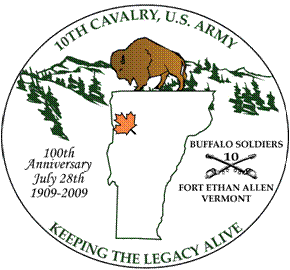
There are Three African American Military Groups that received Medal of
Honors: Buffalo Soldiers, Montford Point Marines, and The Tuskegee Airmen.
The Primus family that lived in Daytona Beach, Florida produced TWO members in
one immediate family!
Source: www.uvm.edu
Source: marineparentsinc.com
Notes: (1)Montford Point Marines existed between the same years as the Tuskegee
Experience, 1941-1949.
(2) Buffalo Soldiers were established by Congress as the first peacetime all
Black regiments in the regular US Army, (1866-1951).They were used in American
Indian Wars, Spanish American War, World War I, World War II, and also to
patrol National Parks such as Yosemite (See Invisible Men: Buffalo Soldiers
of the Sierra Nevada by Shelton Johnson). The famous song by Bob Marley,
"Buffalo Soldier" was a tribute to them.
(3) A notable alumni of Johnson C.
Smith is Albert Manley, class of 1930,
who was President of Spelman College, Atlanta, Georgia, from 1953-1976. Despite
the pernicious racism that existed after slavery was abolished, many of the
HBCUs listed on this page were established by white individuals and received
financial backing by whites. Additionally, these institutions of higher
learning have produced America's most successful and famous African Americans
and are deemed competitive with high academic rankings.
The United States Naval Ship Montford Point was christened by Jackie Bolden, wife of retired Marine Major Charles Bolden and the current administrator of NASA in San Diego, California on March 2, 2013.
It was fitting that the christening took place in San Diego, because San Diego is the location that the 51st Battalion, America's first all Black combat division, was deployed. USNS Montford Point is the Navy's first mobile landing platform (MLP1), and some thirty Montford Point Marines were invited for this special event. As a surviving member of the 51st, my father has vivid memories of California.
Artistic rendering of USNS Montford Point (MP1)
www.sidinfo.com
The "Pier at Sea" costs $500 million and was manufactured by General Dynamics. It is the first of three landing platforms. Present at the ceremony was Montford Point Marine Ed Pfizer of New Orleans, who stated in the Coronado Patch, " I was one of the first ones to sign up. We fought two wars; we fought Jim Crow and we fought the Japanese."
The USNS Montford Point will serve as a 785 foot mobile pier, reducing American Forces' dependency on foreign ports. It also:
--Provides 25,00 square feet space to house vehicles and equipment.
-- Holds 380,000 gallons of fuel
USNS Montford Point source:usnavy
Jacksonville, North Carolina is the site of Montord Point, Camp Lejeune. Montford Point was the Boot Camp for African American Marine Recruits. It is also the same location that my father was demoted from Private First Class for being out of uniform. Dad was wearing a field jacket instead of his official coat in the town of of Jacksonville, North Carolina. Dad reports being "busted down" to Private. It took him an entire year to earn Private First Class again. His honorable discharge papers reads that he earned the rank of "Corporal". He added, "I could of been a Sergeant!"
Dad also discussed his stint riding in an a Jeep with the Navy Shore Patrol. The SPs did not take kindly to Negro Marines. So the Navy, which the Marines falls under, decided to have Montford Point Marines patrol the area with the SPs. Dad stated that an unruly drunk white soldier became violent and called him the "N" word. The soldier was subdued by Dad striking him with the butt of his firearm. Luckily, no one was injured and my Dad was not punished. Which reminds me of the belief that sometimes the enemy is not far away, but resides in close proximity...
From militaryfactory.com:
"The US Marines dates back to 1775 when the first battalions of men were formed under the command of Samuel Nicholas (1744-1790). They assault enemy positions through amphibious means."
Also:
"Their extensive service in the Pacific Theater during World War II Solidified their modern image as one of the best and toughest group of soldiers anywhere in the world."
Congratulations to all Montford Point Marines who were very brave, and now have a state of art vessel named on their behalf. Like their Congressional Medal of Honor, it is a distinction well deserved.


.jpg)

.jpg)