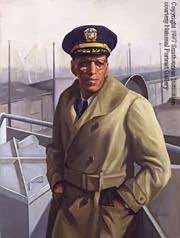
Add this

Monday, November 18, 2013

A Montford Point Marine Veteran Receives a Special Gift from a Businessman


My father received a phone call before heading to his Medal of Honor Congressional Ceremony in June of 2012. It was a local businessman who read about Dad's Montford Point Marines story in the Hartford Courant. His name was John Carmon, a director of a funeral home. Mr. Carmon thanked my dad profusely for serving our country. He said had the utmost respect for soldiers. Mr. Carmon even took it a step forward and offered to pay for all of my dad's travel and lodging expenses to Washington, D.C.

Dad graciously replied that his expenses were already paid by the government, and he appreciated his offer. The business owner countered with paying for an engraved brick. Dad listened as Mr. Carmon explained that the brick would have his name on it and it would be on the walkway at the National United States Marines Corps Museum. Semper Fidelis Memorial Park overlooks the state of the art museum.

So Dad accepted. From the site www.usmcmuseum.com:

"Your engraved brick will affirm for posterity, your esprit de corps with the men and women who risk their lives for the freedom."

An exhibition area from the National Marine Museum. Source: www.usmcmuseum.com


The brick was later spotted by a family member. Mr. Carmon kept his promise. Dad was very touched by the gesture. He laughed, and exclaimed, "These funeral homes love an old geezer like me!" In fact, another funeral home had called to congratulate Dad. The owner of this particular funeral home served in the Army.

Folks in social media heard the news of Dad's Medal of Honor and extended best wishes to him; he was briefly featured on a local news broadcast. It was a culminating experience that brought Montford Marines and the "Lost Battalion", the 51st Defense Battalion, into American History.

I notified all of Connecticut's United State Congress members. They promptly responded with official congratulatory letters addressed to my father. The letters are nicely framed on the living room wall.

Sadly, we saw Mr. Carmon for my mother's funeral in March of 2013. Mother passed suddenly, and they handled the funeral arrangements, just as they did for my brother in 1992. They were always consummate professionals.

The kindness and generosity of the Carmon Funeral Home will always be appreciated. They were there for our family in times of sorrow, and in times of joy. It all started with a compassionate individual responding to a newspaper story and helping out a World War II Veteran. It was a far cry from the Non-Welcoming Military Homecoming my father received after his tour of duty in 1945.


National USMC Museum at night.. The shape of the building is said to invoke the raising of the American flag at Iwo Jima.
Source: Montford Point Marines Association

See the post:  "My Mother: Dorothy Marie Brooks Part II"

Wednesday, November 6, 2013

A Non-Welcoming Military Homecoming for the 51st Defense Battalion, The First WWII Black Combat Division


All of my newly acquired information on Merchant Marines, Hugh Mulzac, and Liberty Ships prompted me to ask my father if he were familiar with the subjects. He listened intently as I described Captain Mulzac successfully ferrying over 18,000 Allied troops across the oceans aboard the Booker T. Washington. "Booker T. Washington," He reflected appreciatively. "Oh yes, I remember traveling on a Liberty Ship to the Marshall Islands. In the beginning of the war we traveled on Liberty Ships. They were rough going, the guys would threw up from motion sickness. Some would vomit right into their food. The "Chow Hounds" would eat the rest of people's food that they didn't throw up in."
"Chow Hounds?," I inquired with amusement.
"You know chow hounds, folks that eat all the time, they weren't too particular about food, they ate everything." Dad chuckled and continued his narrative. "The Liberty Ships would go out at night with a Destroyer and a Destroyer Escort. There were Japanese submarines out there. Towards the end of the war we rode on Victory Ships. They were smoother and they went at six knots an hour. When it was time to go home we traveled on a regular Dutch liner. It took us a month to get home to San Diego."


SS Lane Victory-Victory Class Cargo ships were used in WWII, The Korean War, and Vietnam War. SS Lane Victory named after HBCU Lane College. Now a standing museum and a U.S. National Historic Landmark. Source: hnsa.org


Dad's 51st Defense Battalion was initially viewed as an "Experiment", as the idea of Negros in combat for nonbelievers were wrongfully synonymous with failure. But even during training, the 51st impressed all. First Lady Eleanor Roosevelt personally visited them at Montford Point to witness the Marines practice shooting down drones. Moreover, Montford Point Marines received excellent reviews from their commanding officers as evidenced by official military documents. They completed their duties in the Marshall Islands once the war was over in August, 1945.

It was time to return home for civilian life. Dad remembers the lively guys from Chicago who hired a taxicab to take them from San Diego, California, all the way to the Windy City. That must have been a pricey fare. But Dad also remembers a more poignant memory: His Military Homecoming.

Throngs of people awaited the arrival of the 51st Defense Battalion in San Diego, California. The Red Cross provided coffee and donuts. It appeared the 51st would receive a heroes' welcome, the antithesis of how they were treated before deployment. Indeed, on my dad's way to Montford Point, he was forced to substandard, segregated travel arrangements. Many folks gave uniformed Montford Point Marines a hard time because they resented them being Black Marines. Perhaps with the Allied victory, treatment would be better.

The Red Cross women hugged and greeted White Montford Point Marine Officers warmly after they disembarked from the ship. Excitement and gratitude permeated the air, and refreshments were distributed to the officers. Military celebrations at the end of WWII were epic, monumental occassions.

 And then the festivities were promptly over. For the remaining Black Montford Marines, they were greeted with leftovers. Not one person was around to acknowledge the Montford Point Marines. Not one handshake. It was as if they did not exist.

To this day, my father carried that memory of the Red Cross shunning the 51st Defense Battalion in his mind. For the longest time, he despised the Red Cross. He still had love for the Marines and his country.The bitterness that manifested is similar to many Veterans who return from battle receiving no thanks from their country. There were no parades or glory. Just...nothing. Dad receiving the Medal of Honor eased his pain.


                                                                  Source: suffolknewsdayheraldtribune.com
                                                                                       Artwork by USMC Veteran Timothy Giles.
                                               

See:
http://www.montfordpointmarines.com/


Tuesday, October 29, 2013

First Black Captain of WWII Ship: Hugh Mulzac

A woman from Trinidad once told me that she could never stand for the discrimination that Blacks in the United States had to endure. A Jamaican family friend long ago insisted that she would never sit in the back of a bus, like Negros once had to because of Jim Crow laws. To the woman from Trinidad I gave her a brief history lesson and patiently explained to her what would happen to her if she resisted. She then understood.

 Blacks from other countries often experience a major culture shock upon coming to America. They hail from lands where Blacks are the majority and hold political and social power. This is not to say that Non-American Blacks did not experience discrimination, because many of these countries were colonized by Europeans at one time. But coming to America, from either Africa or places of the African diaspora, one can be in for a rude awakening.

One such person who was subjected to a rude awakening was Hugh Mulzac. He holds the distinction of being the first Black to be captain of a ship during World War II. Stipulated Mulzac:


 "Under no circumstances will I command a Jim Crow vessel."
As you may recall, the Merchant Marines during times of war or national emergency acts as an auxiliary to the military during times of war or national emergency. Hugh Mulzac commanded the Booker T. Washington, one of 18 ships named after prominent African Americans. See Ships named After Famous Black People in WWII: Liberty Ships.


Mulzac was born in the  British West Indies (Union Island, St. Vincent and Grenadines) in 1886. He worked on the sea after high school, traveling on British vessels. The sailor attended Nautical School in Swansea, Wales, where he earned a mate's second in command license. During World War I he sailed as a ship's officer.

Usmm.org


Caribbean-born Mulzac was confronted with the "barbarous customs of our northern neighbor", meaning the United States. He attempted to attend a North Carolina White church while on port of call from a Norwegian ship. Mulzac was refused entry because of his color. This incident became his first exposure to the stinging racism of America's Jim Crow South.

Mulzac later immigrated to the United States in 1918 and became a citizen.  In 1920 he scored 100 percent on the US shipmaster exam. However, there was no shipmaster assignment. The belief system of the day made it difficult for a Black person to captain a ship. Being a cook or cleaning were the few options for a Negro sailor.  In the meantime, he became an expert in food service.
wikipedia.org
Captain Hugh Mulzac with his crew. (Mulzac is fourth from the left)


Hugh Mulzac later served as a mate on the SS Yarmouth, a ship of Pan-Africanist Marcus Garvey's Black Starline, in 1920. He became displeased with the operations and resigned; the ambitious line went out of business in 1922.  Years would go by, and Mulzac held on to his dream of being a captain of a ship. He was a founding member of the National Maritime Union in 1937. A good two decades would pass until finally Mulzac was offered his plum assignment:  Captain of the Booker T. Washington during World War II. Mulzac was 56 years old.
Everything I ever stood for, fought for, dreamed of, came into focus that day. The concrete evidence of achievement gives one's striving for legitimacy, proves that the ambitions were alive, the struggle worthwhile. Being prevented for those twenty-four years from doing the work for which I was trained had robbed life of its most essential meaning. Now at least I could use my training and capabilities fully. It was like being born anew."

Hugh Mulzac had a fully integrated crew representing 18 different nationalities. He was originally assigned an all Black crew, which he refused. Protests resulted in an integrated crew. The Booker T. Washington made over 22 round trip voyages in five years. Under Mulzac the vessel carried 18,000 troops and cargo to Europe and the Pacific. He braved extremely dangerous waters. The Merchant Marines suffered a high ratio of casualty losses compared to the various branches of the military.

German submarines were sinking Merchants Marine ships at a record clip; the Booker T. Washington never lost a crewman to enemy fire. This was due largely to the navigational talents of its submarine dodging captain.

Unlike surviving Montford Marines who are in their seventies-nineties, Hugh Mulzac received limited glory. After the Allied victory he was unable to command a ship. He filled a lawsuit against the ship operators in 1948 and lost. He was also blacklisted for being a member of the labor movement at the height of McCarthyism, where groups associated with Communism were considered Un-American. Mulzac ran for NY Controllers Office and was defeated. He made his living for the next two decades in the steward's department on several shipping lines.
Usmm.org
Hugh Mulzac (1886-1971)


Hugh Mulzac did have success as a self taught painter, however. His works were on display at the Countee Cullen Library, New York City, in the year 1958. Two years later, his license and seaman's papers were finally restored by a federal court.  The former captain was able to work again at age seventy-four--as a night mate. Mulzac died before Merchant Marines would win the right to receive Veteran's benefits.

Hugh Mulzac successfully helped America defeat the Axis Powers by providing his impeccable navigational skills. He made history as the first Black to command a WWII era ship, and repeatedly made the perilous journey of crossing German submarined infested oceans. He ultimately never gave up his dreams of commanding an integrated ship.
aaregistry.org
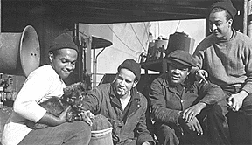
Crew of the Booker T. Washington
with mascot dog.

Sources:
maraad.dot.gov
voyagetodiscovery.org
wikipedia.org
http://hubpages.com/hub/Hugh-Mulzac-First-Black-Captain-of-a-WW2-Liberty-Ship
books.google.Hidden History: Profiles of Black Americans

Notes:

African Diaspora- Countries throughout the world where people of African descent dispersed.

Marcus Garvey (1887-1940)-Jamaican political leader, publisher, journalist, entrepreneur.

McCarthyism-Named after Senator Joseph McCarthy (1908-1957). 1950s era hunt for people believed to be Communist and often without evidence.

Port of Call-  A brief harbor stop where passengers are discharged.

Tuesday, October 15, 2013

Ships Named After Famous Black People in WWII: Eighteen Liberty Ships

 "I'm going to join the Merchant Marines!," a young man who wanted to see the world would often shout in the classic movies. But what exactly did they mean?

The term Merchant Marines refers to the commercial ships or fleet of a nation and to the people who operate them. The United States Merchant Marines also serves as an auxiliary of the Navy in time of war or national emergency, transporting goods or materials needed by the Armed Forces. The United States Merchant Marine has played a vital role in every national conflict since 1775, and played a particularly large and vital part in World War II.      From: marad.dot.gov


                                                                Source: veteranstoday.org

Persons who served in the Merchant Marines are known as mariners, sailors, commercial sailors or seafarers. This organization suffered a high rate of casualties during World War II and were recognized for their impact in 1988 by a federal court. The Merchant Marines had 24,000 African Americans that served in the integrated Merchant Marines during World War II. In a previous post on the Navy's USS Mason, I wrote about the significance of the ship being named after an African American. He was an ensign who was killed in battle.


                                                   Famous Opera Singer Marian Anderson
                                                    christening the Liberty Ship Booker T. Washington.
 
                                                             Source:btwsociety.org


 Merchant Marines had eighteen ships named after famous Black Americans in World War II. This was significant because... well, you already know why if you are a regular reader of this blog. They even had ships named after Historically Black Colleges and Universities.  Liberty Ships were a class of ships quickly constructed during WWII. There were over two thousand constructed and eighteen of the vessels were named after Famous Blacks in Military, Business, and History. Victory Ships were another class of ships. Four of the Victory ships were named after HBCUs.


When I brought up the Merchant Marines to my father, he stated that he had briefly considered joining them in his youth. I am familiar with some of the more famous Black people that the Liberty Ships are named after;  several were named after sailors. One ship was named after an entertainer. Singer and actor Bert Williams' tragic story saddened me. He was an intelligent man in real life, but donned black, minstrel show make-up and a completely dumbed down persona. Williams ended up dying from alcoholism in his forties. I viewed his performances on You Tube and developed an understanding of his dichotomy and inner struggle.

The remaining folks on the list represent individuals who left an enduring legacy in other realms of society. In reading the list, you have to agree that this was a strong class of American leaders.


LIBERTY SHIPS
  1. Booker T. Washington- Leader in Black Community, founder of Tuskegee University.
  2. George Washington Carver- Botanist, scientist and educator, inventor of peanut butter.
  3. Frederick Douglass- Escaped slavery and became a noted writer and statesman.
  4. John Merrick- Successful businessman, founder of North Carolina Mutual Life Insurance Co.
  5. Robert L. Vann- Editor of the Pittsburgh Courier, a national Black newspaper.
  6. Paul Laurence Dunbar- Poet, first African American writer to gain wide attention.
  7. James Weldon Johnson- Writer, lawyer, songwriter, leader of the NAACP.
  8. John Hope- Educator, religious leader, first Black President of Atlanta University/Morehouse College
  9.  John H. Murphy- Publisher of the Afro American.
  10. Toussaint L'Ouverture- leader of the Haitian Independence movement, defeated Napoleon.
  11. Robert S. Abbott- Lawyer, newspaper publisher of the Chicago Defender.
  12. Harriet Tubman- Abolitionist, Union Spy, led slaves through Underground Railroad.
  13. Edward A. Savoy- Traveled to Paris as a US Envoy after the Spanish American War.
  14. Bert Williams- Vaudeville performer, actor, singer, best selling musical artist before 1920.
  15. James Kyron Walker- Second cook, lost on the Gulfamerica when it was torpedoed.
  16. Robert J. Banks- Messman on Gulfamerica, also killed after German attack.
  17. William Cox- Fireman from sinking David Atwater gunned down by Germans.
  18. George A. Lawson- Messman on the Tug Menominee which was torpedoed and sunk.

 VICTORY SHIPS
  1. The Fisk University
  2. The Tuskegee Victory
  3. The Howard Victory
  4. The Lane Victory


                                                                        Source: btwsociety.org
                                                                            Liberty Ship


    Sources: usmm.org   www.wikipedia.org

    Notes:
    Lane College is a Coed, liberal arts college located in Jackson, TN. "The college played a significant role in reducing the rate of illiteracy among Blacks in the South in fewer than fifty years." lanecollege.edu


    See Also:
    A Montford Point Marine and Tuskegee Airmen In One Family  (for info on Historically Black Colleges and Universities)

     USS Mason: The World War II Ship With A Mostly Black Crew                                                        

    Monday, October 7, 2013

    Early Black Military Experiences: Colonial America and the Revolutionary War


    White Americans have been ambivalent over the years about Black participation in military organizations and in most instances have encouraged or allowed Blacks in military activities only when forced by circumstances to do so.  - shsu.edu


    Across the Atlantic Ocean in Europe, defending one's city or country was the responsibility of all male citizens. Wealthy, prominent men became prestigious officers and lower class men served as regular soldiers for service overseas. Similar military practices were adapted in the New World, where settlers from Spain, France, Britain, and the Netherlands established colonies in America.

    The institution of slavery was also brought to America.  A range of policies existed for militia participation of both Free Blacks and Enslaved Africans. Major milestones during the Colonial Era and Revolutionary War listed below gives us a foundation on prevailing attitudes prior to forced desegregation of the armed forces. Early Black Military Experiences included outright banning, and eventually inclusion.  Many of the heroic contributions were quickly forgotten.


    Source: americanrevolution.org
    Reenactment Soldier


    Colonial Era


    1. 1639 - the Commonwealth of Virginia enacted a bill excluding Negroes from being provided with arms or ammunition.
    2. Dutch West Indian Colony of New Amsterdam (New York) armed slaves with a "tomy hawk and a half pike" to assist in fighting murderous Indians (Native Americans).
    3. 1653 - Massachusetts Colony required all Negroes and Indians from sixteen to sixty years of age "inhabitants or servants", to attend Military training along with the English.
    4. New England later followed Virginia in excluding Blacks from the militia. However, this led to Blacks having the same social standing as upper class men who were excluded from the militia. Blacks were then assigned laborer type tasks, such as building defensive fortifications.
    5. South Carolina, on the other hand allowed for "trusty" servants to help in defending the colony in 1703.
    6. Other Southern colonies did not allow for Blacks to become members of militia. There were larger populations of Blacks in the South and the power establishment feared slave mutinies and revolts.
    7. North Carolina, did make an exception when it came to Indian uprisings. In these cases every able bodied man was allowed to help terminate Indian uprisings.


    Revolutionary Hero Salem Poor*
    Source:www.autumnnewell.com 


    American Revolution (America's Independence from Britain) (1775-1783)

    ARMY
    1. 20% of the Colonial population of 22 million was Black.
    2. April 1775 - Black Minuteman fought at Lexington and Concord.
    3. May 1775 - Massachusetts adopted a resolution that no slaves be admitted into the Continental Army. 
    4. July 1775 - Under General George Washington and General Horatio Gates, Continental Amy recruiting officers were not to enlist any "stroller, Negro, or vagabond."
    5. November 1775 - John Murray, Royal Governor of Virginia, representing the opposing British, offered freedom to enslaved Blacks willing to bear arms against the colonists. Murray was known as the Earl of Dunmore or Lord Dunmore.
    6. December 1775 - 300 Blacks joined on the British side with "Liberty to Slaves" etched on their uniforms, calling themselves the "Ethiopian Regiment."
    7. December 1775 - As a result of Dunmore's Ethiopian Regiment, Washington changed part of his policy and allowed free Blacks in the Continental Army.
    8. 1777 - It was reported that some slaves substituted for their masters despite the policy barring slaves.
    9. 1778 - Washington's Continental Army integrated a number of African Americans. There was also an all Black battalion from Rhode Island and Black companies from Connecticut and Boston, called the Colonials and Bucks of America.
    10. 5,000 Black Soldiers fought in the 300,000 Continental Army


    NAVY

     1775 -  Several states paid bonuses to Black crew members and granted freedom. In short, the Continental Navy did not bar Blacks. The Navy was supplemented by individual state and private funding. Ship crews were integrated and Black crew members came with prior maritime experience. (It was reported that some made it up the ranks of pilots; pilots are responsible for navigating a ship through narrow or congested waterways.)

    Secretary of War James McHenry
    Established Policy Banning Negroes in the Marines.
    Source: wikipedia.org


    MARINES

    1. A dozen or more African Americans served in the Marines.
    2. First African American to fight as a Marine was John Martin (Keto). He was enlisted without his Delaware slave owner's permission and saw combat on the USS Reprisal. He was at sea for a year and a half and perished when his ship sank in October, 1777.

    MARINES RE-INSTITUTED

    ***1798 - Marines re-instituted. Secretary of War James McHenry proclaimed, "No Negro, mulatto, or Indian to be enlisted." Following British protocol, the United States Marine Corps enacted a policy which "set a higher standard of unit cohesion for Marines so that they would remain loyal, maintain shipboard discipline and help put down mutinies."

    The Marines did not change their long standing policy until 1942, when Howard P. Perry became their first African American recruit and launched the history of the Montford Point Marines. Protests, letters to Congress, and the Axis Powers' machinations of World War II, led to the signing of Executive Order 8802. It ended discrimination in the National Defense Industry. No longer could Blacks be prevented from enlisting in the United States Marine Corps.

    Throughout history it has been shown that Black participation in military service has been met with reservations. Reasons given include fear of slave revolts and mutinies, not wanting African Americans to ascend the socio-economic ladder, and the belief that Blacks were not intelligent enough to fight in combat situations. In reality, since the American Revolutionary War, Blacks had received high marks and praise from their commanding officers and demonstrated bravery. It is indeed unfortunate that Blacks were able to participate in military service only after military organizations were forced to allow them. So little faith was behind the Montford Point Marines in the 1940s that these soldiers were considered an experiment, and they were sent to outlying regions of the Pacific.

    Early Black Military Experiences demonstrate the willingness for men, who in some cases, did not have their freedom, but were ready to fight. The Colonial Era and the Revolutionary War provided a preview of what Blacks in combat could achieve.

    Source: www.forloveofliberty.org


    Notes:  * Despite Salem Poor's surname, he was able to purchase his freedom as a slave with a year's salary in 1769. Salem Poor was sent to build a fort in Bunker Hill during the Revolutionary War. He killed British Lieutenant Colonel James Abercrombie in Charlestown, MA during combat. The Battle of Bunker Hill had approximately 1,000 African American casualties. 14 American Officers sent a petition to the Massachusetts legislature, proclaiming that Poor "Behaved like an experienced officer as well as an excellent soldier." Salem Poor was featured on an American Postal Stamp two centuries later. From www.fold3.com

    In 1736, Blacks served as officers in a military unit to defeat the Natchez Indians in Mobile, Alabama.  This marked the first time Negroes were officers.


    Sources: shsu.edu

    Thursday, October 3, 2013

    Executive Order 8802 Bans Discrimination In the National Defense Industry

    On June 25, 1941 months before Pearl Harbor, President Franklin Delano Roosevelt signed Executive Order 8802. Executive Order 8802 banned discrimination in the National Defense Industry. The President's official statement accompanying the bill was as follows: "The democratic way of life within the nation can be defended successfully only with the help and support of all groups." Roosevelt was prompted into signing this law by his wife Eleanor Roosevelt, a tireless champion for Black advancement. His decision was also spurred by civil rights activists such as A. Phillip Randolph.  Randolph had threatened a March on Washington.


    Consequently, the United States Marine Corps could no longer prohibit Blacks from joining their ranks. Blacks since the Civil War had been recruited to join the Army and the Navy, but were excluded by the Marines. The 100 plus year policy of exclusion of Blacks was now mandated to change after FDR's signing of Executive Order 8802.


    Howard P. Perry, First Black Marine Recruit
    Source: archives.gov


    The first Black recruit was Howard P. Perry of Charlotte, North Carolina. He arrived to Montford Point on August 26, 1942, and in September he and 119 other privates began the arduous process of becoming Marines.  - National gov. archives

    These Marines were assigned "special housing" at Montford Point. They were not allowed to go to Camp Lejeune unless they were accompanied by a White Marine. Reported Montford Point Marine, Thomas S. Turner, "they didn't want us in there to begin with. They referred us as "you people" as if we were some type of animals. It was rough, but we survived."  -phillytrib.com

    Executive Order 8802 enabled African Americans such as my father to obtain employment in defense factories.* Thousands of Blacks were able to work in defense factories and help our nation at war. Dad was then encouraged to become a Montford Point Marine by James Huger, who worked for the War Department. Furthermore, Blacks could then procure middle class life styles. Executive Order 8802 became an impetus to desegregate other institutions in the future.

    In essence, the contributions of all Americans were needed in the war effort. Months before Pearl Harbor and the United State's entry into World War II, policy makers believed that the contributions of African Americans were necessary. The Montford Point Marines were a result of Executive Order 8802. It essentially banned discrimination in the National Defense Industry. But we know that the Montford Point Marines were in fact, discriminated, since their training facility was segregated and their treatment received was less than honorable.


    Source: Airspace.si.edu


    Notes: Executive Order 8802 did not extend to Japanese Americans; many were placed in internment camps during WWII.


    Sources: lejeuene.marines.mil,www.phillytrib.com,www.veteransunited.com

    * See Previous Related Posts:

    The Person Who Influenced Dad's Decision to Become a Marine
    Dad's Arrival in Connecticut

    Friday, September 20, 2013

    Canadians Sent to Hong Kong in World War II

    Canadians were sent to Hong Kong in November of 1941 for military and political reasons. It was their country's first action in World War II. Canada is a member of the British Commonwealth, and its support was needed to protect Britain's Far East Possessions. The Brits were consumed with the Germans in the European Theater.

     An agreement was brokered for the Canadians to go to Hong Kong in World War II.  Lieutenant General Arthur Grasset, when referring to the Japanese, stated that "they fought well against third rate Chinese, but they had yet to meet first class troops such as his battalions, which would give them a bloody nose." Grasset was the Commanding Officer of China.

    Hong Kong Commanding Officer Major General CM Maltby remarked shortly after the Canadian November arrival:
    And there were only 5,000 Japanese nearby, ill-equipped, short of artillery, unused to night fighting, and their few supporting obsolete aircraft were flown by myopic pilots.


    The stereotype that prevailed in military circles at the time were that the Japanese were nearsighted because of the appearance of their eyelids! This was a belief shared by General Douglas MacArthur as well. Furthermore, the Canadians were not privy to military intelligence. They were sent to war, ill prepared and untrained. The plan was to train them en route to Hong Kong and upon arrival.


    The Royal Canadians and their dog Gander before deployment to Hong Kong. Gander
    sacrificed his life by catching of a grenade meant for soldiers.  Source: canadaatwar.ca.


    Meanwhile, six Japanese fighter and bomber squadrons were assigned to Hong Kong. The attack commenced at 7:30 am, on December 8, 1941. It was scheduled around the same time period as offensive military actions in Guam, Wake Island, Philippines, Thailand, Malaya and Pearl Harbor. The Japanese Squadron obliterated the British aircraft  at Kai Tak Airport.  Bridges were destroyed but accompanying Japanese engineering units quickly repaired the them.

    Hong Kong was considered a precarious situation for years;  Japan already had a million men stationed in China as part of the Sino-Japanese War. Japanese General Lt. Takashi dispatched 52,000 men. The fierce, hardened warriors, who were now seasoned fighters, were no match for the young, inexperienced Commonwealth Soldiers. The Canadians (dubbed  C Force) joined some 14,000 British, Indian and Hong Kong Volunteers.


    Source:wikimedia.org


    Canada sent 1,975 men to Hong Kong in November, 1941. The Canadians deployed two battalions: the Winnipeg Grenadiers and the Royal Rifles of Canada, a brigade headquarters group. They fought diligently for 18 days in the Battle of Hong Kong. Their commander, Maj. Gen. Maltby finally surrendered. The Japanese later stated that despite the overwhelming odds against them, that the defenders fought valiantly. John Osborn of the Winnipeg Grenadiers even received the Victoria Cross, posthumously, in recognition for landing on a grenade to save lives. 550 Canadians did not return; Prisoners of War were imprisoned in Hong Kong or Japan under heinous conditions. Japan unsurprisingly did not support the 1929 Geneva Convention POW Policy that stipulated humane treatment for prisoners. C Force members were later rescued in 1945 from POW camps.


    Source: www.journal.files.ca.


    nilljoreilly.com
    Prisoners of War before rescue. The malnourished men had just received an
    air drop of food from the Allies in 1945.


    Sources: journalforces.gc.ca,historylearningsite.co.uk,www.bbc.co.uk,militaryhistory.about.com,
    http://legionmagazine.com/en/index.php/2011/11/hong-kong-the-inside-story-of-canada-e2-80-99s-role-in-a-doomed-garrison/

    Notes: The Veterans that returned home to Canada were originally treated like outcasts. They eventually received recognition, a former apology, and a museum in their honor.
    Animated Social Gadget - Blogger And Wordpress Tips