Add this

Saturday, February 22, 2014

David Dinkins: Montford Point Marine and Former Mayor of New York


"Let's here it for New York....." the chorus to the Jay Z's "Empire State of Mind" mega hit begins. But an older generation might prefer Frank Sinatra's tribute of "New York, New York." I included these popular songs because a former mayor of the "Big Apple" was a Montford Point Marine. He is the honorable David N. Dinkins, who was elected the first African American mayor of New York City. New York is a world class financial, fashion, cultural, and entertainment center. David Dinkins is 86 years old, and currently a Public Affairs Professor at Columbia University. His policies as mayor has had a lasting impact for the city. This Montford Point Marine describes New York City, a population of over eight million, as a "Gorgeous Mosaic" of ethnicities. New York's population ranks among the top three of the United States, according to the United States 2012 census. Interestingly enough, he became a Montford Point Marine the same way he became mayor: Methodically and with persistence.


image via: nycgo.com


David Dinkins was born in Trenton, New Jersey on July 10, 1927. His parents separated when he was a young boy and his mother moved to Harlem, NY and worked as a domestic. The elder Dinkins later remarried and returned to Trenton where David graduated high school. Essentially, his reason for joining the Marines was his desire to remain alive. He was seventeen years old in 1945 and young men from his neighborhood were rapidly becoming fatalities of World War II. David Dinkins decided to take his destiny into his own hands by taking proactive measures:

And I figured a way to stay alive is to be well trained is to be a Marine. And so I tried to enlist in the Marine Corps. Well, the idea is you have to enlist before you get drafted, because once you're drafted, they tell you where you're going. You say you want Navy, they give you Army. (Uncw.edu)

Source: usata.com


Life As A Marine


 Unlike men who might have shot themselves in the foot to get out of the service, David Dinkins embarked on a mission. He was so determined to become a Marine that he went to sign up in Camden, Philadelphia, Jersey City, Newark, and New York and each time was told that the quota for Negro soldiers was reached. Shortly thereafter, a physical exam revealed that Dinkins had high blood pressure.* This condition would have exempted him from the military but Dinkins remained steadfast. His blood pressure later was normal. Meanwhile a letter was written to the draft board stating if Dinkins passes the exam to place him in the Marines. On July 10, 1945, he turned eighteen. David registered for the draft and requested immediate induction. A little over a week later he was called. (Uncw.edu) 

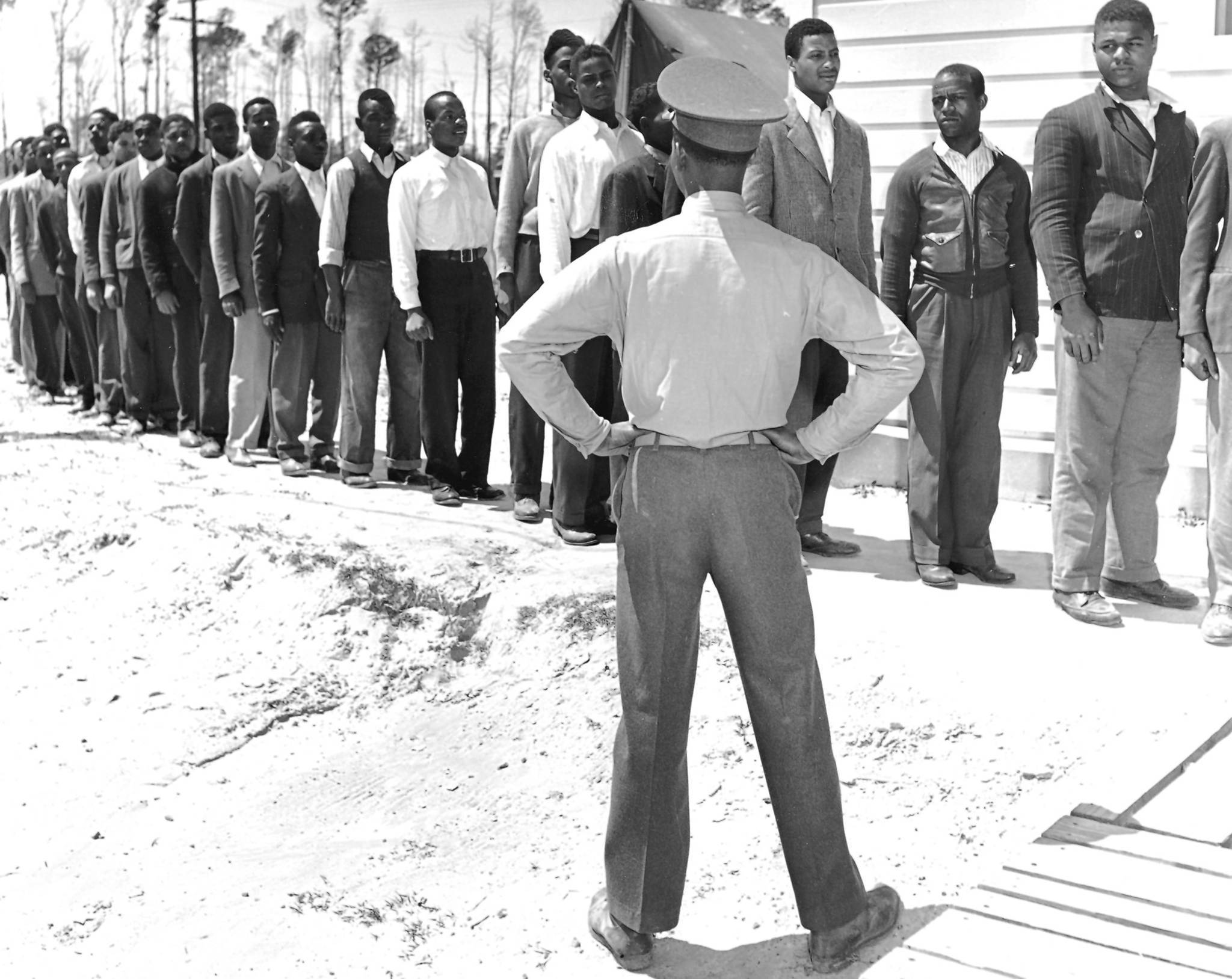
The transcript from University of North Carolina provided a glimpse of boot camp life at Montford Point, Camp Lejeune, North Carolina. The DIs or drill instructors were tough-- he found out the hard way during his first encounter when he was struck by one. Despite the tough training, the scrawny Dinkins was accepting of it because it meant he had to "toe the line." Again, Dinkins signed up because he wanted to remain alive. He was not looking for a way out of the Corps.

Private David Dinkins remained stateside and was a driver at the base, leaving at 4am under cover of darkness. Dinkins was an ambulance driver, and sprayed DDT** according to the taped interview. He also was an assistant file clerk, since he was proven to be very efficient in the office. When it was time to reenlist he decided not to, and enrolled at Howard University in Washington, D.C. upon the urging of his stepmother, an alum. At first he was not very serious with his studies, as he wanted "to party." David Dinkins then became serious and majored in Mathematics, graduating with honors in 1950. He met the smartest girl in his graduate school math class, Joyce Burrows, who later became his wife. Joyce was the daughter of a New York state assemblymen, which led to Dinkins becoming involved in politics.(Uncw.edu, wikipedia)


Source: huffingtonpost.com
David Dinkins while in office.


Life As A Politician


After Howard, Dinkins attended, Rutgers for a fellowship in math and then switched to Brooklyn Law School. He graduated in 1956 and started his own firm. Next, he began his ascent into New York City politics by acquiring access to the inner workings of the political machine, economic clout, and a thick skin. David Dinkins:

Became part of an influential group of African American politicians that included Denny Farrell, Percy Sutton, Basil Patterson, and Charles Rangel, the later three together with Dinkins were known as the "Gang of Four".

Also, New York Daily News reported that Dinkins was one of fifty African American investors who helped the late Percy Sutton*** establish the Inner City Broadcasting Corporation in 1971. Inner City Broadcasting Corporation owned the top ranked urban radio station WBLS and saved the famed Apollo Theater from bankruptcy in 1981.

David Dinkins was President of the Board of Elections from 1972-1973, City Clerk 1975-1985 and Manhattan Borough President in 1985. He was elected the 106th mayor of New York City on November 7, 1989, defeating three term mayor Ed Koch, two other democrat candidates and Rudy Giuliani. He was not elected for another term. Many sources cite the handling of the three day long Crown Heights Riots in 1991, the perception of Dinkins being ineffectual with the crime rate, ethnic tensions, and high voter turn out from the borough of Staten Islandv as factors in contributing to his loss. In Dinkin's memoir, released in 2013 called A Mayor's Life: Governing New York's Gorgeous Mosaic, he candidly talks about his defeat and contributions. (columbia.edu, wikipedia)


New York Faced Special Challenges


New York City in the late 80s and early 90s, like many of America's urban cities, faced many special challenges. A recession, unemployment, gangs, crime, the introduction of the crack epidemic and AIDS wreaked havoc on the residents. Many of my readers might remember when New York overall was deemed a dangerous place filled with urban blight. There was racial discord and violence. Films of the era such as New Jack City and Do the Right Thing, come to mind.


The New York Times in 2009 wrote about David Dinkins achievements as mayor. Highlights include:

  • Decreased the New York City crime rate more than any other time in history. This was done by increasing the size of the New York Police Department and the hiring of Raymond W. Kelley as police commissioner. 
  • Instituted Beacon Community Centers that provided a wide range of services.
  • Revitalized a once decaying Times Square and negotiated with Walt Disney Corporation to repair an old 42nd Street theater.
  •  Established significant rehabilitation of dilapidated housing in Harlem, South Bronx and Brooklyn despite budget constraints
  • Procured a 99 year lease from the United States Tennis Association for New York City, cited as the best athletic stadium deal in the country.
  • Enacted policies and actions that reduced the homeless population to its lowest point in 20 years.

David Dinkins also is involved in countless social organizations such as 100 Black Men, Alpha Phi Alpha, Inc., and serves on numerous boards. The Columbia University website lists his implementation of "Safe Streets, Safe City: Cops and Kids" crime reduction program for children in addition to involvement in various municipal leadership organizations.


So there you have an achievement packed life of one Montford Point Marine. David Dinkins decided to be proactive about his military career as a teenager to insure that he did not to become a casualty. He took steps to enlist as a Marine, because he knew that he would receive the best training out of all the Armed forces. He did not give up after five USMC recruitment offices said "No, we reached our Negro quota." Higher ups noting his persistence wrote a letter insisting that he be allowed to become a Marine.

The Congressional award winning Montford Point Marine then later served as an politician for one of the most important cities in the world. Dinkins described New York as a city with the "Gorgeous Mosaic" of people. He established ground-breaking policies for millions of residents and was in office with the largest crime drop in New York City history. Since then, the appealing luster of The Big Apple from a golden era has been restored. More individuals are apt to sing the metropolis' praises in a song, like the two I included in the introductory paragraph.

David Dinkins was able to achieve two important goals in his life; becoming one of the first Black Marines and the first Black mayor of New York City.


Would you have been as persistent as Dinkins in becoming a Marine during WWII?  Have you ever visited or lived in New York in the 1990s? What about today?

Sharing is caring! Follow the Montford Point Marines and Honor Blogspot on Pinterest.


                                          visionaryproject.org


See also:

They Don't Tell You Where You're Going


Sources:

columbia.edu
www3.istat.it
newyorkdailynews.com
nytimes.com
takeaway.org
uncw.edu
visionaryproject.org
wikipedia.com


Notes: *high blood pressure- Incidence of high blood pressure for US Blacks is 41% due to genetics, environmental and social factors. Source: webmd.com


**DDT-pesticide


***Percy Sutton- Also a Congressional Medal Recipient. Sutton was an intelligence officer and an aviation cadet with the Tuskegee Airmen. Sutton, an attorney, provided legal representation for Malcolm X.  Profiled at visionaryproject.org


Friday, February 14, 2014

The Passing of A Hartford Legend: Walter "Doc" Hurley


I was in the final stages of locating photos and creating an outline on one of the most famous Montford Marines when something appeared across my feed in a social media account. It was a tribute drawing from Bob Englehart, a political cartoonist from the Hartford Courant. The illustration read "Doc Hurley." I immediately was touched because my father used to play cards with Coach Walter "Doc" Hurley. Just last year we drove down Hurley's former street and my father pointed out the Tudor house that overlooked Keney Park. I discussed Doc Hurley's passing with my father and he reiterated how his late older brother Jay used to play football as an undergrad against Hurley on an opposing HBCU team. Both men were extremely tall and a long lasting friendship occurred between two giants whose statures alone did not define them. My late Uncle Jay would see Doc Hurley when he came to visit us in Connecticut.

"I didn't know he was a Marine," I said. Dozens of news sources plus a book stated he served in the Pacific during the 1940s as a Marine. As this blog's loyal readers already know, that would automatically make him a Montford Point Marine, since Montford Point was where all African American Marines were trained at the Camp Lejeune facility prior to desegregation. Thus, with supporting documentation, Doc Hurley should receive a Medal of Honor posthumously.

Source: Hartford Courant


Walter "Doc" Hurley- 1922-2014

Walter "Doc" Hurley was an educator, school administer and basketball coach. He was born in Albany, Georgia and moved to Hartford, CT where he was a four sport star athlete. Hurley graduated from Weaver High School in 1941 and served in the Marines. He attended Virginia State University and spent his summers in Hartford as a supervisor in a parks and recreation program. Hurley was a towering, commanding man with the "intense stare" and booming voice. Some of his young men that Hurley coached even made it to the NBA; they later reflected in a 2006 article from the Hartford Courant on the influence that Doc Hurley had:

In those days you didn't call them mentor, but that's what he was. He was the largest person I had ever seen. He was larger than life to me, and in a way still is."

Hurley played Professional football in the 1940s with the All American Football Conference Brooklyn Dodgers. He was a winning high school track and football coach and a noted basketball official in Virginia. He also began his teaching career there. Despite Hurley's successful reputation, when there was a basketball coach vacancy at Hurley's alma mata, Weaver High School, Hurley was passed over. Hartford simply was not ready for a Black coach at the time. Even today, headlines are still made when an African American is made a collegiate or professional sports coach. Said Hurley, "it stung" and according to the article Hurley "never got over it." (Hartford Courant)

Doc Hurley in 1940
Image via wfsb.com


It was Doc Hurley that calmed some 500 Weaver High School students down on April 4, 1968, when Dr. Martin Luther King, Jr. was assassinated. Doc Hurley wasn't a teacher at Weaver, but he was summoned from his physical education job at an elementary school to prevent frustrated students from protesting. Hurley arrived and gathered the football team, since he knew many of them as kids by name, along with leaders of street gangs to diffuse the potentially violent situation. His quick-thinking paid off as Weaver High School remained unscathed while Hartford's North End was ravaged by riots for months. He asked the question, "Where are you going to get educated if you burn down the school?" Now that's power. (Hartford Courant)

The educator went on to become an assistant principal at Weaver High School and set up the Doc Hurley Basketball Tournament in 1975. Over a half million dollars in college scholarships have been given out over the years with the criteria based on academics, an essay and financial need.

"There are hundreds of people from throughout the Hartford area whose lives were transformed because of the higher education opportunities that Doc Hurley brought to their lives over the past several decades," Gov. Dannel P. Malloy said Monday. "He was one of the most passionate voices for Hartford and its residents, respected by all, and brought such positive energy to generations of residents. He truly is a Hartford legend and is proof that one person can make a lasting, positive impact." Hartford Courant

Unfortunately, great things can become temporarily tarnished. State officials allege that his daughter misused college funds for her own personal use. A new scholarship fund has been established through the Hartford Foundation for Public Giving, called the Walter Doc Hurley Scholarship Fund for Greater Hartford. Flags were flown at half mast under the direction of Hartford Mayor Pedro Segarra, and the girls and boys Weaver High School Baskeball teams are dedicating the rest of their season in Doc Hurley's honor. They will be wearing jerseys with Doc Hurley's name on them. (Hartford Courant)


 And how did Walter Doc Hurley get the moniker "Doc?" His father wanted him to grow up to become a doctor so that he could be successful. I think this Marine did remarkably well, don't you? Do you know any educators like him? Would it be awesome to Hurley's legacy if he is honored with a Congressional Award posthumously?


Don't forget to subscribe for future posts, become a follower and share.


Hartford Courant file photo.


Sources:
FoxCT.com
Hartford Courant
Hartford.org

See Also:
A Montford Point Marine and Tuskegee Airmen in One Immediate Family
Connecticut: The Land of Steady Habits


Notes:

* Gwen Hurley, the wife of Doc Hurley, preceded her husband in death in 2005. She taught at Mark Twain Elementary for many years and also had a lasting impact on young people and the Hartford community. My friend Pat, an administrator, would speak fondly of Mrs. Hurley and her sayings.


Wednesday, February 5, 2014

Alfred Masters Becomes the First Black Marine Inducted into the Armed Services

It is very commonplace to know someone in the military. If you ask around, there is someone in your circle, extended circle, family, workplace who is a member of the armed forces. You might have known someone who was in the ROTC in high school, or in the Reserves. A classmate might have attended college courtesy of the G.I Bill.* But prior to 1942, Black Marines did not exist. Not even in support positions, like the other branches of the military in the United States.

 In Executive Order 8802 Bans Discrimination in the National Defense Industry, I described how this law prohibited discrimination in federal government positions and the armed forces. It was signed by Franklin Delano Roosevelt on June 25, 1941, and ended the centuries long tradition of the United State Marine Corps barring Blacks from enlisting. (See Early Black Military Experiences: Colonial America and the Revolutionary War for a synopsis on African American Soldiers in the Armed Services.)


According to Leatherneck Magazine, Major General Commandment Thomas Holcomb testified before the General Board of Navy on January 23, 1942, that "There would be a general lost of efficiency in the Marine Corps if we take Negroes." Holcomb also said that "given the choice between having Marine Corps of 5,000 Whites or 500,000 Blacks, he would rather have the Whites."

Obviously, the upper echelons were not pleased into taking African Americans enlistees. However,with increasing pressure, the Marines had to comply. The Marines purchased land to establish barracks at New River, North Carolina in early 1941. It was a 1600 acre tract. Montford Point was named after Colonel James Montford, a heralded Civil War veteran whose family's roots extend to the American Revolution. (Marine Corps Combat Service Support Schools)


On 26 April 1942, Montford Point was opened under the command of Colonel Samuel A. Woods and a select group of enlisted staff noncommissioned officers (SNCO's). This group of SNCO's were known as the "Special Enlisted Staff." Their mission was to set up the camp and then function as drill instructors for the new recruits. The first black Marine recruits were selected for their leadership and demonstrated maturity for they would be the backbone of the black SNCO/Drill Instructor core. Nearly 20,000 African-American recruits were trained at Montford Point until 1949, when the U. S. military was fully integrated. (MCCSSS)


So Montford Point was specifically set up for Colored recruits to have separate barracks and other supporting facilities, along with specialized training. Recruits were carefully selected. But I have come across seemingly conflicting reports on who the first Black Marine was. Admittedly, I was confused; I saw photos of Howard P. Perry, but then I saw Alfred Masters. There could not be two "firsts." So I had to look closer to answer the question. The answer is this: Howard P. Perry of Charlotte, North Carolina has the distinction of being the first Black recruit. Perry reported to boot camp in August 26, 1942. The first Black Marine recruit to be sworn in was Alfred Masters on June 1, 1942 at 12: 01 a.m. in Oklahoma City, Oklahoma. Masters was inducted into the Corps in his home state out west, and then traveled to Montford Point, Camp Lejeune, NC.(montfordpointmarines.com)


Technical Sargeant Alfred Masters
Source:  commons.wikimedia.org
First Black Marine


The wife of Alfred Masters, Isabel Masters recalled:

"Alfred and I were on the elevator at the post office in Oklahoma 
City with a Marine recruitment officer who asked Alfred if he wanted 
to be the first Black Marine. Of course, the answer was yes. Alfred 
was wearing a Langston University sweater, which prompted the 
recruiter to accost him. On June 1, 1942, Monday morning, one 
minute after midnight, Alfred was inducted into the armed services as 
the first Black Marine. In Texas, however, another young man was 
inducted one minute after 8 a.m. as the first Black Marine. However, 
Alfred's name is always listed first, being a degree of controversy about it."
                   montfordpointmarines.com


Source: Flickr
Montford Point Boot Camp


New Montford Point Marine Recruits, New River, NC
Department of Defense


For Alfred Masters, his induction into the Corps meant that he took a sacred oath promising to adhere to it for his entire military career. Alfred Masters becomes the First Black Marine inducted into the Armed Services on June 1, 1942. Masters and other recruits at Montford Point in the summer of 1942 were positioned to be influential game changers.


Have you heard about the Montford Point Marines prior to reading this blog? If so how? Don't forget to become a subscriber to Montford Point Marines and Honor Blogspot!


Please share this post in honor of Black History Month! Black History is American History.


Notes:
Montford Point was renamed Camp Johnson in honor of Sergeant Major Gilbert "Hashmark" Johnson, a nineteen year Army and Navy veteran. Johnson was a Montford Point Marine drill instructor. (mccsss)

Langston University is a public university located 45 minutes from Oklahoma City, OK in Langston, OK. It was founded in 1897 and is considered the westernmost historically Black college in the US, from Langston.edu, wikipedia.


*G.I.- "Government Issue," Veterans Benefit Program used for education, business loans, housing, etc.
ROTC-Reserve Officer Training Corps
Reserves-A military organization of citizens who combine a military role with a civilian career.


**Repost: The daughter of Alfred Masters notified me that the previous picture identified with her father was incorrect. I immediately switched to the above correct photo and apologized for the error.  


Leatherneck Magazine
Marine Corps Combat Special Support School
Montford Point Marine Association


Wednesday, January 29, 2014

Army's Red Ball Express: Unsung Soldiers


I wrote extensively about the Port Chicago Naval Magazine Explosion and the Port Chicago Mutiny, involving the mostly African American sailors who loaded munitions bound for the Pacific Theater. The explosion was the worst homeland disaster of World War II and the Port Chicago Mutiny was the largest naval mutiny at the time. July 14, 2014 is the 70th anniversary of the explosion; ceremonies will pay respect to the fallen seaman and civilians. Here is another story of unsung African American soldiers...


The European Theater was the location of the United States Army's Red Ball Express, where again, African American soldiers comprise the majority of the personnel. Allied troops in Europe desperately needed ammunition. But in this case the ammunition was transported strictly by land; rations, medical supplies, and fuel also needed to be rapidly distributed.

The Operation was given the code name Red Ball Express. Red Ball Express was a truck convoy transportation system that traveled across Northern France. The supply line was essential after the largest amphibious landing in military history. Red Ball Express was created on August 25, 1944 in Normandy, France. Its name was borrowed from an old fashioned term for fast freight trains that contained perishable food.

Did you know that 75% of its drivers were African American?* They were members of the Army's Quartermasters Corps. Again, the belief system at this time maintained that Blacks did not have the guts necessary for being a soldier of combat. African American males were considered "intellectually inferior."As a result, the ranks of World War II military, with notable exceptions, swelled with Blacks in support positions.

However, in order to survive the Red Ball Express supply line, you had to have guts.


Army's Red Ball Express:  Unsung Soldiers


Amazon.com


If you originally thought that Red Ball Express drivers were affable Negros, mindlessly shuttling around a military base, you are incorrect. Now some may think that being a driver in the war is not glorious, but these drivers took their work seriously. Travel by motor vehicles was necessary as the French railroad system was completely destroyed. This was done to thwart the Germans. The operation commenced shortly after the D Day invasion. D Day, or the Normandy Invasion, marked a turning point in World War II. (D Day warrants separate, future posts due to the enormity and vast scope of this historical invasion)


I asked my father about the Red Ball Express and he had a great deal of respect in his voice. He said that they had a dangerous job because they had to avoid the Wehrmacht, the German military. "You remember that?," I asked. "Yeah, he bragged, "I know a lot about the war," was his reply.

He did not personally know any drivers but I explained that the father of the late singer Whitney Houston was a Red Ball Express Driver. According to US Army Transportation Museum.com, John Huston stated:

“We ran [the trucks] through summer, fall and winter, through snow, ice and rain.  Guys were falling asleep all the time.  You couldn’t get enough rest.”
Also, in viewing the aftermath of war torn French towns, Houston recalled:
"Each town was a monument to hell itself."


b/w photo of Blackwell and Houston
John Rockwell (l) and John R. Huston
Source: US Army Transportation Museum


 Driving for extended periods of times, the men faced sleep deprivation yet they had to stay alert. Veteran James Rookard recalled drivers and relief drivers learning to switch positions while the vehicles were in motion. German bombs and gunfire attacks were always a possibility on those trecherous roads. The roads had signs, traffic signals and military police directing traffic. At nighttime, truck headlights had special "cat eye covers", in order to diminish detection by the German Army. If a truck was no longer working, the truck had to be abandoned and left on the side of the road. Mobile pit crews would come along and repair the trucks (Source: blog.cleveland.com)

 Over fifteen hundred Army vehicles were repaired each day (Source: DOT).   Red Ball Express soldiers had to deal with debris in the road from shrapnel. They also had to deal with inclement weather, starving people begging for food, dead bodies, and bombs, remembered James Rookard.  Drivers obviously had to persevere under time constraints and the constant fear of being attacked. There was also added pressure to succeed because news reporters covered their stories back home.

The entire Red Ball Express operation was a massive initiative launched by General George S. Patton, Jr.; it lasted 82 Days according to Department of Defense. What good is having strategic, tactical plans towards the Allied victory if your troops are unequipped?  This particular operation provided forward momentum for the Allied troops after the D Day invasion.


From DOT.gov:

The plan was to gather nonessential trucks from throughout the European Theater. Although General Eisenhower had wanted tractor-trailers for the Red Ball Express, the primary vehicle was the versatile 2½ ton six-wheel-drive General Motors truck nicknamed the "Jimmy" and "deuce-and-a-half." They would operate 24 hours a day on two designated two-lane, one-way roads, reserved almost exclusively for the trucks, totaling around 600 miles at the peak of service. The northern route was closed to all traffic except convoys delivering supplies, while the southern route was closed to all but returning trucks.

Additionally:


The Red Ball Express began operating on August 25, 1944, with 67 truck companies, 3,358 trucks, mostly Jimmies, carrying 4,482 tons of supplies on a 125-mile run from Cherbourg to the forward logistics base at Chartres. Just 4 days later, the Red Ball Express included 132 truck companies and 5,958 vehicles. [Victory , p. 49]

Source:defense.gov


In closing, Red Ball Express was a major convoy system that supplied Allied soldiers fighting on the French front line. It was a top secret plan that was launched after D Day. The mostly Black drivers, mechanics, minesweepers and others of the Red Ball Express ultimately helped the Allies gain victory in World War II. Please share the incredible story of the Army's Red Ball Express and its Unsung Soldiers.


Some readers may say, "I see no color when fighting along my comrades." This may be true. But the question is, is it now possible to represent color when describing American military history, instead of omitting groups? When percentages are as high as 75%, such as the Red Ball Express' African American drivers, can a more accurate representation be granted? What do you think?


*US Department of Defense

Sources:
defense.gov
blog.cleveland.com
fhwa.dot.gov
history.net
pbs.org
Personal Stories: Red Ball Express


Notes: Hollywood had its own version of the Red Ball Express, simply named Red Ball Express. The titular film was released in 1952 and featured a predominately White cast. A young pre-Academy Award winning Sidney Portier appeared in this movie. The script had some rewrites after issues raised by the Black press.
CBS had a TV show called Roll Out in 1973-74. Roll Out aired for only twelve episodes, and was produced by the same team as M.A.S.H. There was also a 1994 US Postage Stamp dedicated to the Red Ball Express. ( Source: DOT)
See also: powerlines/robert k chester

Thursday, January 23, 2014

Port Chicago Mutiny and the Port Chicago 50

"Hi, Papa Clifford!" It was my best friend, checking in on my dad because she heard he was in the hospital. He was now at home, and she was concerned. "I'm sorry, who is this?" my dad asked in his formal tone, the one he uses when he is "handling business."
"It's me, Pebbles!" Dad then laughed, happy to hear from my best friend. They chatted for a while. Dad immediately felt better. Pebbles is a lawyer and sometimes edits my posts when she is not in court. She is very excited that I will be writing about the Port Chicago Mutiny because civil rights icon Thurgood Marshall was involved with it. She received a "Thurgood Marshall Scholarship" while an undergrad at Howard University.

Thurgood Marshall spent the better part of his life in the twentieth century fighting civil rights. As a matter of fact, if you look up "Civil Rights", you are bound to see a picture of the stalwart Thurgood Marshall pictured in front of a courthouse, or in a distinguished robe as a US Supreme Court Justice Judge, the highest court of the land. If I were one of the African American soldiers being tried for mutiny, I would want Thurgood Marshall defending me. Winthrop's Military Law and Precedents defined mutiny as "to usurp, subvert or override superior military authority."

I described the harrowing tragedy of the Port Chicago Naval Magazine Explosion, the worst homeland disaster of World War II earlier this week. The explosion happened on July 17, 1944. Tons of ammunition being loaded onto Liberty ships exploded, instantly killing over three hundred people, the majority African American sailors. The Black enlistees were forced to quickly load the materials onto Liberty ships at Port Chicago, CA by their officers.  2014 marks the 70 year anniversary of the event, and commemorative memorials will take place across the United States.


I am quite sure that if you were a survivor of such a horrific event, you would not be fond of returning to work in an an unsafe environment. You probably experienced trauma as a first responder after viewing the mangled remains of bodies that were incinerated. Imagine being told to go back to the pier to do the same back breaking and dangerous assignment. Without given any protocols.

The 328 surviving Black enlistees refused. Fifty men were singled out and charged and convicted of mutiny. The men cited the Navy's lack of care for their safety. They wanted Navy officials to change procedures but the Navy refused to comply with their wishes. So the men were rounded up and arrested.
 Two hundred eight of these men were court-martialed, sentenced to bad conduct discharges, and the forfeit of three month's pay for disobeying orders. Fifty of them men, however, were charged with outright mutiny, a crime punishable by death. They would be known as the Port Chicago 50.  No Port Chicago sailor convicted of mutiny was sentenced to death; however, most were sentenced to eight to fifteen years of hard labor. In January of 1946, however, all of the accused were given clemency and were released from prison.
- See more at:blackpast.org

Scene from Paul Leaf's 2009 play,  Mutiny at Port Chicago.
Source: latimesblog.com


It was reported that the trial was for thirty days and deliberations were for 80 minutes, including lunch-time.
According to lighthousedigest.com, the prosecutor was naval officer James Frank Coakley, who claimed that the the sailors were "depraved" men who didn't want to work. In reading the research, I was utterly amazed at how the Black enlistees were subject to exaggerated claims and trickery. Their officers were viewed in a positive light and considered heroes; some even received Navy and Marine medals for bravery.

 Thurgood Marshal, the attorney on the appeal, put up a "valiant defense." Marshall was Chief Counsel for the NAACP and would argue 32 cases before the Supreme Court, and the famous Brown v. Board of Education that led to desegregation of public schools. (lighthousedigest.com)


Thurgood Marshall
Source: americaslibrary.gov


Furthermore, in addition to the discriminatory practices of placing Black men as the only ones handling the materials and hiring them in menial positions such as stevedores, Thurgood Marshall found that the 12th Naval District:

Ignored official cautions by the San Francisco waterfront union before the Port Chicago catastrophe and that an explosion was inescapable if they continued in the use of untrained seamen in the loading of ammunition.
The Navy dismissed an offer by this same union to dispatch skilled men to instruct Navy personnel in the proper handling of explosives. In addition, it came out that division officers of Port Chicago actually placed bets from $5 and up as to whose crew could load more ammunition. ( lighhousedigest.com)

Thanks to the persistent efforts of Thurgood Marshall, the NAACP, and letters written to the government, the Port Chicago 50 received clemency. The Pittsburgh Courier, the African American newspaper with the largest circulation in the 1940s, provided continuous coverage of the events. Petitions and protests were critical components on the outcome of the Black sailors.


 Many years later, according to history.com, a 1994 review concluded that the trial had strong racial overtones. On December 23, 1999, President William Clinton pardoned Freddie Meeks of Los Angeles, one of the few still living members of the original 50. Meeks wanted everyone to know about his plight and the story behind the Port Chicago Mutiny. Some individuals believed that asking for a pardon was essentially admitting to guilt, but Meeks remained steadfast in his desire to get the story of the Port Chicago Mutiny/Port Chicago 50, back out into the nation's consciousness.

The Port Chicago Mutiny caused the Navy to change their procedures for loading munitions. After the trial, men had to become certified in order to load these special materials. Port Chicago, therefore, proved to not only be a civil rights case, but also a human rights issue. Moreover, Port Chicago Mutiny struck a chord with journalists who discovered the case decades years later and decided to investigate it. Professors and people in the performing arts were inspired to research and create works of art, bringing the Port Chicago 50 into the media and dialogue.

Historians point out that the Port Chicago Disaster also was a factor in desegregating the military. Blacks needed to have an opportunity for advancement in the armed forces and not be confined to segregated, menial positions. Prevailing attitudes of the day that fostered discrimination had to be eliminated. In essence, Port Chicago Magazine Naval, the worst homeland disaster in WWII, and the Port Chicago Mutiny/Port Chicago 50, the largest naval mutiny in at the time, became a catalyst for change in the military. It enabled the military to take an introspective look on how it treated its personnel, and the need to be proactive in protecting all of its members in perilous situations.


comicbookjustic.com


So what do you think? Would you have been brave enough to stand up to a commanding officer and inform him that you weren't going to load those explosives?  If you were a wronged survivor, would you be willing to ask for a pardon after all those years?

Don't forget to subscribe to this blog via email, receive notifications and follow Montford Point Marines and Honor Blogspot on Pinterest.

Please share this post in honor of the 70th anniversary of the Port Chicago.


70 year anniversary of Port Chicago is this year.
nps.gov


blackpast.org
history.com
lighhousedigest.com
nytimes.com-"Freddie Meeks Pardon"
usmm.org

See also:  Pittsburgh Courier, "A Non-Welcoming Homecoming For the 51st Defense Battalion"


Notes: Port Chicago Mutiny has been the subject and title of a NBC movie in 1999. It starred Michael Jai White and Duane Martin and was directed by Kevin Hooks. Morgan Freeman is listed as one of the executive directors. There has been plays, documentaries, a symphony, artwork and books on the subject. An episode of the CBS TV drama JAG devoted a story line on a  survivor in 2002. The Port Chicago Mutiny, written by Richard Allen in 1989, is the foremost reference on Port Chicago.

Sunday, January 19, 2014

Port Chicago Explosion: The Largest WWII Homeland Disaster


On my previous post I discussed Operation Crossroads and included a controversial photo of an atomic bomb test cake.  A reader named Shirley Wilson, a professional cake designer from San Francisco, linked the plight of the sailors in an incident to the Montford Point Marines. I posted a portion of her comment and asked my readers if they knew about the incident in question. 

Some of my scholarly viewers automatically answered to themselves "Port Chicago."

Similarly, other scholarly viewers collectively shared a blank response. The incident was not publicized and was buried for over fifty years. It took investigations and testimonials to uncover this homeland disaster that became both a civil and human rights case. There now is a Port Chicago Naval Magazine Memorial.  So if you Googled and asked for help, or a lifeline, I will understand, because I myself didn't know about the case. Here is the fascinating story of Port Chicago...


Port Chicago Explosion: The Largest WWII Homeland Disaster

nps.gov


Port Chicago Naval Magazine was a segregated naval base located 40 miles east of San Francisco, CA. Black men were required to load ammunition and bombs onto ships. Ships were headed out to Pacific Rim troops during World War II. The Allies were desperate to stop the Japanese and other Axis powers that were raging massive destruction.

After World War I, the Navy excluded African Americans and replaced them with Filipinos. In 1932, the Navy permitted Blacks, but only in menial positions and of course, not as officers. Port Chicago had 1,400 Black enlisted men, 71 officers, 106 Marine Guards and 230 civilian employees. (Usmm.org)


sfgate.com


It was critical to load the Liberty and Victory ships 24 hours around the clock. Tragically, pressure was on to quickly dispatch munitions without any regard for safety or specialty training. It was reported that the enlisted men even waged contests to increase their output. The Black men toiled long hours and worked without facial masks to protect them from toxic dust. Furthermore, their supervisors were White officers who harbored discriminatory attitudes towards them. Navy survivor Morris Soublet* reported being called "boy" and the group of Negro men as "you people." 


usatoday.com


Can you imagine working in not only a hostile work environment, but employed around highly combustible materials, with no instruction on how to properly handle the munitions, and commanded to move quickly? The Black enlistees had some fears about working with the materials but blocked them out after the officers told them they would be safe "because the bombs did not have detonators on them." Clearly all these elements were a dangerous recipe for disaster. 


The E. A. Bryan had been moored at Port Chicago for four days, taking on ammunition and explosives night and day. Some 98 men of Division Three were hard at work loading the Bryan, and by 10:00 p.m. on 17th July the ship was loaded with some 4,600 tons of munitions including 1,780 tons of high explosives. (rense.com)

Rense.com also states:

In addition to the enlisted men present, there were nine Navy officers, 67 members of the crews of the two ships along with an Armed Guard detail of 29 men, five crew members of a Coast Guard fire barge, a Marine sentry and a number of civilian employees. The pier was congested with men, equipment, a locomotive, 16 railroad boxcars, and about 430 tons of bombs and projectiles waiting to be loaded. 

On that fateful day in July 17, 1944, a powerful explosion occurred and it registered 3.4 Richter scale. In fact, people that survived in the area and miles beyond thought an earthquake occurred. A large mushroom like cloud appeared and .an airplane pilot flying reported seeing debris pass by the size of a house. The blast was felt 200 miles away. Windows were shattered and structures in the town of Port Chicago were damaged. The death toll was 320 men (200 Black), and 390 Military and civilians injured. (233 Black). Property damage was 12 million dollars, a staggering sum at the time. 

nps.gov


The grim task of recovering bodies, attending funerals and memorials took place immediately after the tragedy. Amazingly enough, the White officers were praised and allowed leave, but the Black enlisted men were not. Surviving Black enlistees were sent to load another ship. The workers refused to work in such hazardous conditions. What happened next became the largest Naval mutiny trial in history, known as the Port Chicago Mutiny.

The Port Chicago Explosion is known as the largest WWII Homeland Disaster. Conspiracy theorists point to classified documents and describe the "mushroom cloud" that appeared; individuals involved in the creation of these bombs referred to subsequent explosions as "Port Chicago-like" explosions. 


What feelings do you have when you look at some of these pictures? What would you do if you were an enlisted man? Please share this post and don't forget to sign up to be notified for future posts.(Or subscribe via "Feedly")


Follow the Montford Point Marine and Honor Blog on Pinterest.

Next up: "Port Chicago Mutiny"


abc.net.au


Portchicagoexplosionblogspot.com
Port Chicago Naval Magazine Memorial 


Notes: 


Friday, January 17, 2014

Operation Crossroads and the Atomic Bomb Test Cake

It all started with Pinterest. Pinterest is a major social media site where members pin favorite photos, infographics, articles and recipes on virtual boards. Its usage has grown significantly over the years, with businesses turning to visuals to increase brand awareness and sales. "Pinners," as they are called, pin items that appeal to them. You can discover lots of history just by perusing peoples' boards or doing a keyword search. Pinners that share your interests will follow you, and you can reciprocate.

It turns out that I pinned a photograph of a rather unusual picture of an atomic bomb test cloud cake. Yes, I said atomic bomb test cake. Marshall Islands, where my father and other Montford Point Marine members of the 51st Defense Battalion were stationed, later became an atomic bomb testing site. The Marshall Islands are located in the Pacific Ocean. Bomb testing took place after World War II on the Bikini Atoll*. For obvious reasons bomb testing sites are in isolated low population areas.  Scientists are compelled to test the effectiveness of weapons in warfare, and atomic bombs were no exception. Specifically, US President Harry S. Truman wanted to test the effects of atomic bombs on war ships.


From Bikini Atoll.com:
In February of 1946 Commodore Ben H.Wyatt, the military governor of the Marshalls, traveled to Bikini. On a Sunday after church, he assembled the Bikinians to ask if they would be willing to leave their atoll temporarily so that the United States could begin testing atomic bombs for "the good of mankind and to end all world wars." King Juda, then the leader of the Bikinian people, stood up after much confused and sorrowful deliberation among his people, and announced, "We will go believing that everything is in the hands of God."

While the 167 Bikinians were getting ready for their exodus, preparations for the U.S. nuclear testing program advanced rapidly. Some 242 naval ships, 156 aircraft, 25,000 radiation recording devices and the Navy's 5,400 experimental rats, goats and pigs soon began to arrive for the tests. Over 42,000 U.S. military and civilian personnel were involved in the testing program at Bikini.

When bombs were detonated, a thick cloud immediately appeared, pumping dangerous radioactive chemicals into the atmosphere. The US government allowed the Bikinians to return to their island in 1968, after declaring the island safe. However, many islanders were exposed to chemicals in their food supply and developed health problems such as thyroid cancer. Residents left their island again. (japantimes.co)


 But the picture in question was celebratory in nature.
Infamous Cakes: In November 1946 the Joint Army-Navy Task Force Number One was celebrating the successful Operation Crossroads nuclear test at the Bikini atoll with a mushroom-cloud shaped cake. The photo, showing Vice Admiral William H.P. Blandy (commander of the task force), his wife and Rear Admiral Frank J. Lowry, was published in the Washington Post. 
Conelradblogspot.com


 A cake designer saw the photo and was amazed that an elaborate baked good was created resembling an an atomic bomb cloud. I thought the idea was  "interesting" which is why I posted it. But the cake designer happened to live in the San Francisco Area. She read some of my posts via Pinterest since there is a Montford Point Marines and Honor Blogspot Pinterest page. Her candid comment was:


I am a cake designer and I wouldn't make a cake like this, ever! Reading about the Montford Point Marines brings to mind the black sailors who served in..... 


I replied that I never heard of them but I would look into it, and write about the incident.So my next story will be the controversial story about an incident involving African American Sailors.  Many theories and questions remain and it took decades to resolve. We have cake designer Shirley Wilson to thank for the post.  Follow the "Montford Point Marines and Honor Blogspot" board on Pinterest. Some of the photos you might find in future posts...

What are your thoughts about the Operation Crossroads atomic bomb test cake? Do any of my readers know about the incident that cake designer Shirley Wilson was referencing? (I omitted the rest of her remarks deliberately.)


Bikini Atoll Evacuation, 1946 on left.
Modern day Marshall Islanders on right.
In 2010 Bikini Atoll was designated a World Heritage Site.
bikiniatoll.com


Note: The above cake photo was denounced by a minister named Arthur Powell Davies. Davies wrote a scathing letter on how insensitive the celebration was, especially in lieu of the fact that hundreds of thousands died as a result of the atomic bombing of Japanese cities Hiroshima and Nagaski. (August, 1945)


See also:

 Indigenous People of the Pacific.
Why the 51st Defense Battalion Were Sent to the Marshall Islands


*Atoll- An island made of of coral reef encircling a lagoon.
Bikini-The minimalist two piece bathing suit was named after the island in 1947 by a French designer.
  .
Animated Social Gadget - Blogger And Wordpress Tips